Last reviewed
Background
A canal city where mercantile wealth became gardens, food, scholarship and a highly walkable historic core.
Yangzhou stands north of the Yangtze on waterways that connected the lower river to the Huai and the wider Grand Canal system. Founded in the Spring and Autumn period and known historically as Guangling, it prospered repeatedly as a transport, trade and salt-administration center. The UNESCO-listed Grand Canal includes the Yangzhou section of the Huaiyang Canal, but Yangzhou is more than a preserved waterway: the canal still structures the old city, waterfronts and modern museum district.
Imperial-era salt merchants helped shape Yangzhou’s private gardens, refined cooking and patronage of painting and performance. Surviving places such as Ge Garden and He Garden reveal both artistic ambition and the unequal wealth behind it, while Huaiyang cuisine, morning tea, Yangzhou Qingqu and craft traditions remain living parts of the city rather than decorative nostalgia. Yangzhou has been a UNESCO Creative City of Gastronomy since 2019.
Recommended itineraries
Recommended itineraries
Yangzhou’s headline sites are close enough for a compact visit, but gardens reward unhurried attention and morning tea belongs at the start of a day. Reserve a separate block for the modern canal museum.
Lake, gardens and old-city lanes
A compact first visit centered on the city’s best-known landscape, garden and canal layers.
- Day 1 · Begin with Yangzhou morning tea, spend the main part of the day around Slender West Lake and continue to Daming Temple. Return to the center for Wenchang Pavilion and an evening walk rather than rushing into another ticketed garden.
- Day 2 · Visit Ge Garden early, continue through Dongguan Street and the adjoining old-city lanes, then give He Garden a separate architectural visit. Finish with the Ancient Canal waterfront or an authorized evening cruise if current operations and weather suit.
Canal, gardens and cultural memory
A slower route that adds a museum day and smaller cultural sites without turning the old city into a checklist.
- Day 1 · Follow the classic Slender West Lake and Daming Temple pairing, leaving time for the temple’s Jianzhen context and the lake’s historic landscape design.
- Day 2 · Explore Ge Garden, Dongguan Street and nearby lanes, then choose the Yangzhou Eight Eccentrics Memorial Hall or Shi Kefa Memorial Hall before visiting He Garden.
- Day 3 · Make the China Grand Canal Museum the anchor, booking through its official channel in advance. Pair it with Sanwan Park or a clearly defined Ancient Canal section, not a compressed cross-city sequence.
Attractions & practical tips
What to see—and how to approach it.
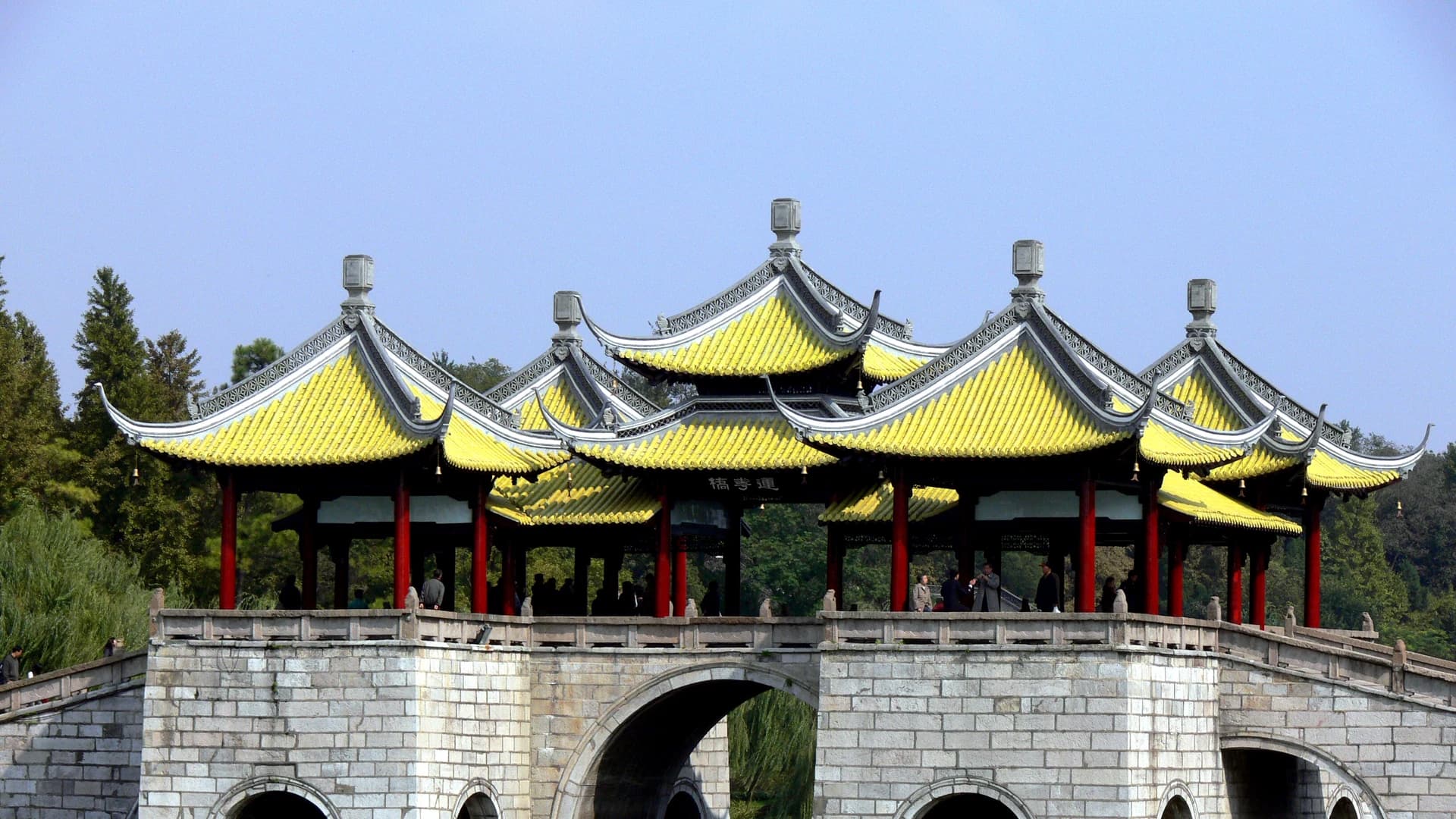
Slender West Lake
瘦西湖
A long, narrow lake landscape northwest of the old city, composed through causeways, bridges, pavilions and framed views rather than one open sheet of water.
Practical tips
- Allow at least half a day and choose a directional walk; crossing the same long grounds twice wastes energy.
- Slender West Lake appears on China’s World Heritage tentative list, but it is not itself an inscribed World Heritage property. Check its official notices for current admission, boats and night access.
Ge Garden
个园
A Qing-period salt merchant’s residence and garden celebrated for bamboo, compact architecture and rock compositions that evoke the four seasons.
Practical tips
- Look beyond individual photo spots: the sequence from residence to bamboo courts and seasonal rockeries is the garden’s central idea.
- Use current signs to distinguish conserved fabric, restoration and later visitor circulation, and expect congestion around holiday bottlenecks.
He Garden
何园
A late-Qing residence and garden known for its layered corridors, domestic courts, rockwork and a design that makes a relatively compact property feel spatially complex.
Practical tips
- Follow the upper and lower corridor levels deliberately; moving too quickly makes the garden’s overlapping sight lines hard to understand.
- Treat the house as evidence of elite family life and changing late-imperial architecture, not simply as a romantic film set.
Daming Temple
大明寺
A Buddhist complex on Shugang whose long history is closely associated with the monk Jianzhen, remembered for his eighth-century journeys and cultural exchange with Japan.
Practical tips
- Dress and speak respectfully because this remains a religious site, and separate worship spaces from general sightseeing.
- Pair it with the north end of Slender West Lake, but verify the actual exit and walking route rather than relying on the old guide’s distance claims.
Dongguan Street and the old city
东关街与扬州古城
Dongguan Street is the most visible commercial spine of a broader lived-in historic area where lanes, residences, small museums, craft shops and everyday services coexist.
Practical tips
- Step into adjoining public lanes instead of treating the pedestrian street as the whole old city, but respect homes and private courtyards.
- Eat selectively and avoid assuming that every antique-looking shop or façade is historic; commercial reconstruction and older fabric sit side by side.
Yangzhou Ancient Canal
扬州古运河
The urban canal corridor links bridges, old wharves, residential streets and traces of the trade system that connected Yangzhou to the much larger Grand Canal network.
Practical tips
- Choose one specific walking or boat section; ‘the Ancient Canal’ is not a single compact attraction with one entrance.
- Use only authorized cruises, confirm the current boarding point and last service, and keep waterfront alternatives for storms or high winds.
China Grand Canal Museum
扬州中国大运河博物馆
A large contemporary museum in the Sanwan area interprets the Grand Canal across its full geography and history through archaeology, objects, reconstructed environments and digital displays.
Practical tips
- Reserve through the museum’s official channel; the permanent exhibitions are free, but timed admission and popular dates can fill.
- Give the museum several hours and pair it with nearby Sanwan Park rather than inserting it between old-city gardens.
Yangzhou Eight Eccentrics Memorial Hall
扬州八怪纪念馆
A small art-focused memorial in a former temple setting introduces the loosely connected Qing-period painters later grouped as the ‘Eight Eccentrics of Yangzhou.’
Practical tips
- Use it to understand the city’s art market and patronage rather than expecting eight artists with one shared style or manifesto.
- Confirm current gallery access and exhibition content before making it a fixed stop; it works best beside other central old-city sites.
Shi Kefa Memorial Hall
史可法纪念馆
A memorial complex near Meihualing presents Shi Kefa and the violent 1645 fall of Yangzhou during the Ming–Qing transition through later halls, texts and commemorative space.
Practical tips
- Approach it as a site of war, death and changing historical memory, not a light decorative stop.
- Allow time to read the interpretation critically and distinguish seventeenth-century events from later rebuilding and commemoration.
Zhu Ziqing residence and Wenchang Pavilion
朱自清故居与文昌阁
The modest former residence of twentieth-century writer Zhu Ziqing and the Ming-period Wenchang Pavilion in today’s traffic center offer two different views of Yangzhou’s literary identity.
Practical tips
- Treat these as separate short stops rather than one formal attraction; the pavilion is best appreciated from the surrounding public space.
- Check the residence’s current opening status and avoid planning a long detour if access is limited.
Food & dining
Eat with a little local context.
Yangzhou is a UNESCO Creative City of Gastronomy and an important center of Huaiyang cuisine, known for precise knife work, controlled heat and balanced savory flavors. Breakfast tea houses are as important as formal restaurant dishes.
Yangzhou morning tea
扬州早茶
A leisurely tea-house breakfast combines tea with steamed buns, dumplings, pastries, noodles and small savory dishes rather than one fixed set menu.
Try it this way: Go early, order in stages and confirm fillings because pork, shellfish and meat-based stock are common even in small-looking items.
Yangzhou fried rice
扬州炒饭
Rice, egg and finely cut savory ingredients are stir-fried so the grains remain distinct; recipes vary rather than following one universal tourist formula.
Try it this way: Ask what meat or shellfish is included and share it with other dishes instead of treating a large plate as the entire meal.
Dazhu gansi
大煮干丝
Pressed tofu is cut into exceptionally fine strands and gently cooked with a rich stock and selected toppings, making knife skill central to the dish.
Try it this way: The broth often contains chicken, ham or shellfish, so it is not automatically vegetarian despite the tofu base.
Crab-roe lion’s head meatballs
蟹粉狮子头
Large, tender pork meatballs are slowly cooked with crab roe or crab meat for a rich Huaiyang banquet dish.
Try it this way: Order one portion to share, confirm seasonal crab availability and expect both pork and shellfish.
Yangzhou salted goose
扬州盐水鹅
Poached or gently cooked goose is seasoned for firm, savory meat and is commonly sold by weight at specialist counters and stalls.
Try it this way: Buy from a busy, clean vendor, confirm the weight and price before cutting, and refrigerate leftovers promptly.
Three-diced steamed bun
三丁包子
A soft fermented bun encloses diced chicken, pork and bamboo shoot, combining juicy filling with contrasting textures.
Try it this way: Eat it hot at morning tea and ask before ordering if you avoid pork or poultry; the filling is not interchangeable with a vegetable bun.
FAQ
Questions worth answering before you go.
How many days should I spend in Yangzhou?
Two days cover Slender West Lake, Daming Temple, the two major gardens and an old-city walk at a sensible pace. Add a third day for the China Grand Canal Museum, smaller memorials and more time around the canal.
When is the most comfortable time to visit?
Spring is celebrated in poetry and brings flowers, but it is also a peak period with heavier crowds and higher demand. Autumn is often comfortable for walking. Summers are hot, humid and storm-prone, while winters can be cold and damp; check a current forecast rather than relying on the old guide’s fixed seasonal claims.
Do I need to reserve attractions in advance?
Reserve the China Grand Canal Museum through its official channel and check current notices for the major gardens, Slender West Lake and Daming Temple during weekends and holidays. The PDF’s old prices, combination tickets and opening hours are not reliable.
Can I explore Yangzhou without a car?
Yes. The old-city gardens, commercial lanes and central landmarks work well through a mix of walking and short public-transport or taxi trips. Slender West Lake, Daming Temple and the canal museum form separate clusters, so use a current map rather than the obsolete bus numbers in the source.
What should I know before ordering morning tea?
Arrive early and expect popular tea houses to queue. Order a few items first, then add more; buns, dumplings and broths may contain pork, poultry, shellfish or lard, so travelers with allergies or dietary rules should ask about each filling and stock.