Last reviewed
Background
A Naxi cultural landscape shaped by mountains and trade.
Lijiang sits in northwest Yunnan, where the foothills below Jade Dragon Snow Mountain meet old trading routes and the cultural homeland of the Naxi people. Water channels, stone lanes and timber courtyard houses give the historic settlements their character, while Dongba traditions add a living cultural layer beyond the scenery.
Dayan, usually called Lijiang Old Town, is the busiest base; Shuhe and Baisha offer quieter ways to read the same wider landscape. Treat these places as neighborhoods rather than open-air sets: keep voices low near homes, ask before photographing people, and leave enough time for unplanned walks instead of turning every lane into a checklist.
Shuhe is not a separate heritage property: it is one of the three settlement components of the UNESCO-listed Old Town of Lijiang, alongside Dayan and Baisha. Its lanes, springs and courtyard houses developed within a trading landscape where routes between Yunnan, Sichuan and Tibet supported exchange among Naxi, Han, Bai and Tibetan communities.
Shuhe’s water channels, market spaces and craft history make most sense as parts of a living settlement rather than a nostalgic stage set. Tourism now shares the town with homes, worship, small businesses and contemporary Naxi cultural life, so responsible visits support local interpretation and respect private courtyards instead of treating every doorway as public access.
Recommended itineraries
Recommended itineraries
Three days cover the old towns at a comfortable pace; allow two or three additional days for Lugu Lake rather than compressing the long road journey into a day trip.
Old towns at an easy pace
A lower-pressure introduction that prioritizes Lijiang’s historic settlements and leaves room to adapt to the altitude.
- Day 1 · Walk Dayan Old Town, visit Mufu and climb toward Wangu Tower only if you still have energy.
- Day 2 · Start at Black Dragon Pool, then spend the afternoon around Shuhe’s lanes and waterways.
- Day 3 · Continue to Baisha for village-scale streets and Naxi cultural context, keeping the evening free back in your chosen old-town base.
Lijiang with a mountain day
A balanced first visit combining the historic core with one full-day landscape excursion.
- Day 1 · Settle into Dayan Old Town, visit Mufu and explore the quieter lanes away from the main squares.
- Day 2 · Make Jade Dragon Snow Mountain the day’s single major outing, with Blue Moon Valley or another nearby stop only as conditions allow.
- Day 3 · Visit Black Dragon Pool, then continue north to Shuhe for a slower afternoon.
- Day 4 · Choose Baisha and its surrounding countryside, or replace the day with Tiger Leaping Gorge if you are prepared for the longer journey.
Lugu Lake extension
A separate overnight extension for the lake’s villages, peninsulas and Mosuo cultural landscape.
- Day 1 · Travel from Lijiang to the Yunnan side of Lugu Lake, settle near Daluoshui or Lige and walk a short lakeside section before sunset.
- Day 2 · Follow a selective lake route through Lige, Gemu Goddess Mountain or Caohai and the Walking Marriage Bridge, then return only if the current road schedule allows an unhurried journey.
Lugu Lake at a slower pace
A lake-focused route that trades a rushed full circuit for village time, ecological context and one carefully chosen cross-shore day.
- Day 1 · Travel from Lijiang, settle on the Yunnan shore and explore Daluoshui or Lige on foot without adding a long evening transfer.
- Day 2 · Use licensed road transport for a selective lake circuit. Combine Xiaoluoshui and Gemu Goddess Mountain with either the eastern Caohai wetland or a short trip from an official pier; wear the provided safety gear and let weather or crowd controls shorten the plan.
- Day 3 · Visit the Mosuo Folk Museum or Zhamei Temple for community and religious context, then leave enough daylight and schedule margin for the return to Lijiang.
Shuhe heritage day
A compact walking route that reads Shuhe through its market, bridge, water source and Tea Horse Road history.
- Morning · Start around Shuhe Sifang Street before the busiest period, cross Qinglong Bridge and follow the older lanes instead of staying on the commercial approach.
- Midday · Visit the Tea Horse Road Museum for trade and craft context, allowing time for lunch away from the main square.
- Afternoon · Continue upstream to Jiuding Longtan, then return slowly along the channels and residential edges without entering private courtyards.
Shuhe, Baisha and Yuhu
A slower northern-Lijiang extension linking two World Heritage settlement components with a mountain-foot village.
- Day 1 · Explore Shuhe on foot through Sifang Street, Qinglong Bridge, the museum and Jiuding Longtan, keeping the evening free rather than adding another old town.
- Day 2 · Continue to Baisha, then choose Yufeng Temple and Yuhu Village with the Joseph Rock residence if time and current access allow. Arrange licensed transport or verify the current public route; cycle only if you are comfortable with altitude, traffic and changing weather.
Attractions & practical tips
What to see—and how to approach it.
Dayan Old Town
大研古城
Lijiang’s main historic quarter, known for stone lanes, running water, timber buildings and a street pattern that rewards slow exploration.
Practical tips
- Motor vehicles do not serve the inner lanes, so pack light and confirm the walking route to your accommodation before arrival.
- The busiest squares change character after dark; explore early in the morning for a quieter view of the neighborhood.
Mufu and Wangu Tower
木府与万古楼
Mufu introduces the local ruling family’s history, while the hillside around Wangu Tower provides a broader view across tiled roofs toward the mountains.
Practical tips
- Visit Mufu before wandering the old town if you want historical context for the buildings around it.
- The climb toward Wangu Tower involves uneven steps; take it slowly and skip it if the altitude is already affecting you.
Black Dragon Pool
黑龙潭
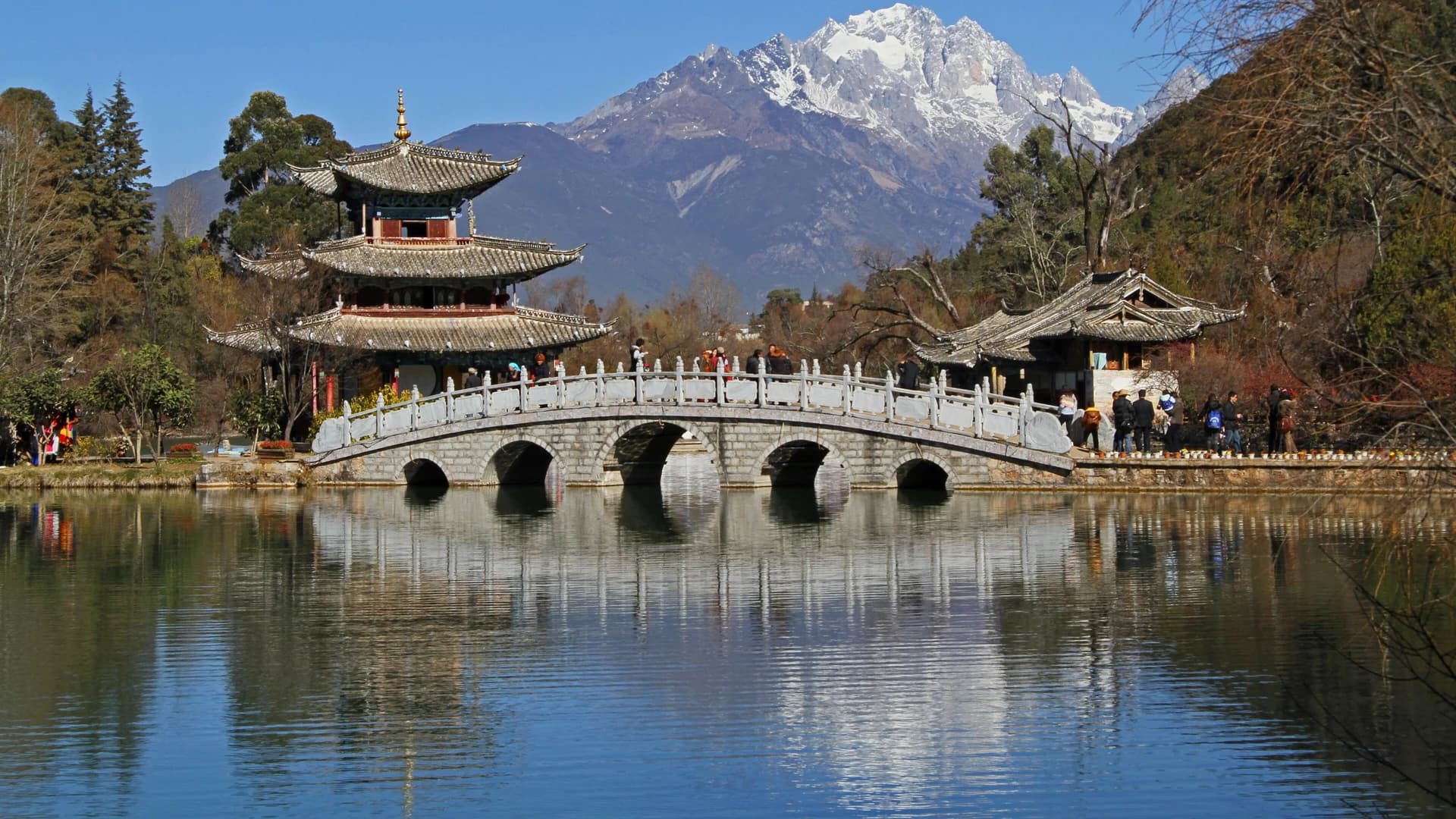
A landscaped pool and temple complex north of Dayan, closely associated with Lijiang’s classic mountain reflection and nearby Dongba cultural institutions.
Practical tips
- Clear mornings offer the best chance of seeing Jade Dragon Snow Mountain behind the water.
- Pair the park with a northbound visit to Shuhe rather than crossing back and forth through the city.
Shuhe Old Town
束河古镇
A historic settlement north of Dayan with lanes, waterways and traces of the Tea Horse Road, generally experienced at a gentler pace than the central old town.
Practical tips
- Walk beyond the commercial entrance streets before deciding what Shuhe feels like.
- It works well as a half-day stop combined with Black Dragon Pool or Baisha.
Shuhe Sifang Street
束河四方街
Shuhe’s compact historic market square connects several lanes beside flowing water and recalls the settlement’s role as a local trading stop.
Practical tips
- Arrive early enough to notice the square’s scale before shops and visitor traffic dominate the scene.
- Use it as an orientation point, then continue into the lanes rather than treating the square as the whole town.
Qinglong Bridge
青龙桥
A stone bridge across the Qinglong River on Shuhe’s historic route, with a weathered surface that links the market area to quieter lanes.
Practical tips
- Cross slowly and leave room for residents and other pedestrians on the narrow approach.
- After rain the old stone can be slick, so wear shoes with reliable grip.
Shuhe Tea Horse Road Museum
束河茶马古道博物馆
A small museum in a restored courtyard complex that connects Shuhe’s trade history with local schooling, leatherwork and wider cultural exchange across southwest China.
Practical tips
- Visit before the town’s craft shops so the objects and courtyard architecture have clearer historical context.
- Confirm current opening and interpretation arrangements locally instead of relying on the PDF’s old listings.
Jiuding Longtan
九鼎龙潭
A clear spring-fed pool at the upper edge of Shuhe and an important source for waterways that run through the settlement.
Practical tips
- Follow the channels upstream from the old town for a more legible view of how water shapes the settlement.
- Do not feed fish or throw objects into the pool; enjoy reflections only when light and weather make them visible.
Shuhe lanes and waterways
束河街巷与水系
The most rewarding part of Shuhe is often the connected texture of stone lanes, bridges, channels, gardens and courtyard fronts beyond any single landmark.
Practical tips
- Keep to public lanes and never assume an open gate makes a residential courtyard a visitor attraction.
- Use a map to maintain direction, but allow a quiet hour for a loop without a fixed photo checklist.
Baisha Old Town
白沙古镇
A smaller settlement closer to the mountain, valued for village-scale streets, Naxi heritage and a quieter relationship with the surrounding countryside.
Practical tips
- Approach Baisha as a lived-in village and be considerate around homes and working courtyards.
- Allow time for the journey back rather than assuming transport will be as frequent late in the day.
Yuhu Village
玉湖村
A Naxi village of stone-built homes at the foot of Jade Dragon Snow Mountain, where heritage conservation, daily life and contemporary rural tourism meet.
Practical tips
- Treat the village as a community first: stay on public routes, ask before photographing people and support locally run interpretation where possible.
- The mountain setting changes quickly with cloud and weather, so make the village itself—not a guaranteed reflection photo—the reason to visit.
Joseph Rock Former Residence
洛克故居
A modest residence in Yuhu associated with botanist and writer Joseph Rock’s long period of research in northwest Yunnan, now interpreted within the village’s Naxi setting.
Practical tips
- Read Rock’s work alongside local and Naxi perspectives rather than treating one foreign observer as the sole authority on the region.
- Confirm current access in the village, since small heritage interiors may change hours or close temporarily.
Yufeng Temple
玉峰寺
A small mountain-foot Buddhist temple known for its wooded setting and an old camellia courtyard, adding religious and botanical context to the northern-village route.
Practical tips
- Keep voices low, follow photography restrictions and give worshippers priority in active religious spaces.
- Confirm access before adding it to a tightly timed route; flowering conditions are seasonal and never guaranteed.
Jade Dragon Snow Mountain
玉龙雪山
The high mountain massif north of Lijiang anchors the region’s landscape, with scenic areas that can include glacier viewpoints, meadows and the turquoise water of Blue Moon Valley.
Practical tips
- Make it the only fixed major outing of the day and confirm current reservations, weather and operating conditions locally.
- Ascend gradually, stay hydrated and turn back if you feel unwell; altitude affects travelers differently.
Lashi Lake
拉市海
A wetland and rural landscape west of Lijiang associated with seasonal birdlife, village scenery and routes connected to the old Tea Horse Road.
Practical tips
- Choose activities only after confirming the route, duration and full price with a reputable operator.
- The landscape and birdlife vary by season, so visit for the wetland setting rather than a guaranteed checklist of sightings.
Tiger Leaping Gorge
虎跳峡
A dramatic gorge on the upper Yangtze between Jade Dragon and Haba snow mountains, visited either as a long day trip or as a multi-day hiking destination.
Practical tips
- Do not combine a serious hike with another major Lijiang attraction on the same day.
- Trail access and conditions can change with weather; check locally and carry suitable footwear, water and layers.
Lugu Lake
泸沽湖
A highland lake spanning the Yunnan-Sichuan border, surrounded by mountains, peninsulas and Mosuo communities.
Practical tips
- Treat it as an overnight extension because the road journey from Lijiang is substantial.
- Confirm current roads, entry rules and return transport rather than relying on the source guide’s old schedules.
Daluoshui Village
大落水村
A principal visitor base on the Yunnan shore, with lake access, transport connections and a lived-in Mosuo community beyond the waterfront businesses.
Practical tips
- Its services make arrival straightforward, but stay on public lanes and ask before photographing residents or homes.
- Use the village for a short lakeside walk rather than trying to complete a full-lake circuit after the road journey.
Lige Peninsula
里格半岛
A compact peninsula and lakeside village beneath Gemu Goddess Mountain, known for layered views across the water.
Practical tips
- Walk beyond the main viewpoint to understand the peninsula’s relationship with the village.
- Stay on marked routes and keep noise down around homes and guesthouses.
Xiaoluoshui Village
小落水村
A smaller settlement on the northern Yunnan shore, where village lanes and the lake sit beneath Gemu Goddess Mountain.
Practical tips
- Visit as a community, not as a staged ethnic attraction; private courtyards require an invitation.
- Confirm return transport before lingering late because services are less concentrated than at Daluoshui.
Caohai and Walking Marriage Bridge
草海与走婚桥
Reed-filled wetland at the lake’s eastern side is crossed by a long wooden footbridge associated with Mosuo courtship traditions.
Practical tips
- Visit for the wetland landscape and local context, not a simplified romantic myth.
- Follow conservation paths and do not step into reed beds or disturb birds.
Luowa Wharf
洛洼码头
A Sichuan-side lakeshore stop near the transition between Caohai’s reed wetland and the lake’s open water, useful on a selective eastern-shore route.
Practical tips
- Use only an operating official pier and a licensed boat; wear the provided life jacket for the entire trip.
- Skip the boat when wind, visibility, closures or crowd controls make conditions uncertain.
Gemu Goddess Mountain
格姆女神山
The highest mountain beside Lugu Lake holds deep importance in Mosuo belief and provides a defining backdrop to the northern shore.
Practical tips
- Treat sacred stories and pilgrimage activity respectfully rather than as entertainment.
- Check current mountain access and weather before choosing any ascent or cableway.
Zhamei Temple
扎美寺
A Tibetan Buddhist monastery in Yongning that reflects the religious connections linking Mosuo communities with the wider northwest Yunnan highlands.
Practical tips
- Confirm current public access locally and remember that worship takes priority over sightseeing.
- Dress respectfully, keep voices low and follow all posted photography restrictions.
Liwubi Island
里务比岛
A small island in the southern lake with a Tibetan Buddhist monastery and wide views back toward the surrounding shores.
Practical tips
- Use only licensed local boats and wear the provided safety equipment.
- Keep voices low at the monastery and follow photography restrictions.
Mosuo Folk Museum
摩梭民俗博物馆
A community-rooted museum presenting Mosuo material culture, social history and changing contemporary life through objects and local interpretation.
Practical tips
- Use the museum to add depth before interpreting family structures or ceremonies from brief tourism encounters.
- Check current opening arrangements locally and do not substitute staged home visits for consent-based cultural learning.
Food & dining
Eat with a little local context.
Lijiang’s food reflects Naxi traditions, Yunnan ingredients and the cool highland climate, while a Lugu Lake extension adds Mosuo preserved foods, buckwheat and simple shared dishes. Look beyond the busiest visitor streets, order for the group and confirm ingredients when needed.
Lijiang baba
丽江粑粑
A layered wheat cake served in savory or sweet versions, with a crisp exterior and filling texture that makes it an easy snack.
Try it this way: Try a freshly cooked portion and share one first, since styles and richness vary between shops.
Jidou liangfen
鸡豆凉粉
A local chickpea jelly served cold with a bright, savory dressing or pan-fried for a warmer, firmer dish.
Try it this way: Ask whether the shop recommends the cold or fried version for the day’s weather.
Naxi cured pork rib hotpot
腊排骨火锅
A warming shared pot built around cured pork ribs, vegetables and a savory broth suited to Lijiang’s cool evenings.
Try it this way: Order for the group size and add vegetables gradually, as the cured meat can make the broth increasingly salty.
Black goat hotpot
黑山羊火锅
A hearty local-style hotpot centered on goat meat, commonly paired with greens, mushrooms and dipping sauces.
Try it this way: Confirm the portion before ordering side dishes; hotpot sets can be larger than expected for one or two diners.
Erkuai rice cakes
饵块
Chewy Yunnan rice cakes that may be grilled, stir-fried or served in soup, making them useful for breakfast or a quick meal.
Try it this way: For a lighter snack, choose a grilled version and ask for sauce or chilli in a small amount first.
Naxi-style grilled fish
纳西烤鱼
Fish is marinated, grilled or fried and finished with an aromatic savory sauce, often with chilli, herbs and vegetables.
Try it this way: Ask which fish is being served, confirm the portion and request a milder seasoning if you are sensitive to chilli.
Naxi rice sausage
米灌肠
A traditional savory sausage combining rice, pig’s blood and seasoning inside a casing, then steamed or pan-fried in slices.
Try it this way: Ask for a small portion to share and tell the kitchen about dietary restrictions, since both the filling and cooking fat matter.
Buckwheat baba
荞面粑粑
A rustic buckwheat cake served around Lugu Lake, with an earthy flavor and dense texture.
Try it this way: Try it warm alongside soup or vegetables rather than expecting a sweet pastry.
Mosuo preserved pork
猪膘肉
A rich salt- and spice-cured pork preparation traditionally preserved in large pipa-shaped cuts and sliced or cooked into shared dishes.
Try it this way: It can be intensely salty and fatty, so begin with a small shared portion and ask how the kitchen serves it.
Chicken and mushroom stew
土鸡菌菇汤
A warming highland-style broth combining chicken with locally available cultivated mushrooms and seasonal vegetables.
Try it this way: Ask which mushrooms are used and choose a licensed kitchen; do not buy or forage unidentified wild fungi.
Roasted potatoes and vegetables
烤土豆与时蔬
Potatoes, eggplant and other vegetables are grilled with savory seasoning for a simple snack along the lake route.
Try it this way: Choose a clean, licensed stall, request chilli separately and avoid wildlife meat or unidentified lake species.
Lugu Lake grilled fish
泸沽湖烤鱼
Freshwater fish is grilled simply and served as part of a shared lakeside meal.
Try it this way: Ask about the fish, sourcing and portion before ordering, and avoid protected or unidentified species.
Sulima wine
苏里玛酒
A lightly fermented grain drink associated with Mosuo households and hospitality around Lugu Lake.
Try it this way: It contains alcohol; accept only a small serving if you drink and decline politely when you do not.
FAQ
Questions worth answering before you go.
How many days do I need in Lijiang?
Allow three days for Dayan, Shuhe, Baisha and nearby cultural stops at a comfortable pace. Add a fourth day for Jade Dragon Snow Mountain or Tiger Leaping Gorge rather than squeezing a major landscape trip between old-town visits.
Can a taxi take me directly to my old-town hotel?
Usually not to a property deep inside the pedestrian lanes. Confirm the nearest vehicle drop-off and the walking route with your accommodation, especially if you have wheeled luggage or arrive after dark.
Should I plan around Lijiang’s altitude?
Yes. Keep your first day relatively easy, hydrate, limit heavy exertion and avoid scheduling a high-mountain trip immediately after arrival. Seek medical help if symptoms are severe or do not improve with rest.
Should I stay in Dayan, Shuhe or Baisha?
Dayan offers the widest choice of food and evening activity, Shuhe is calmer while retaining visitor services, and Baisha feels smaller and more village-like. Choose the atmosphere you want, then check the exact walking and transport access before booking.
Should I cycle from Shuhe to Baisha and Yuhu?
Only if you already ride confidently and feel well at Lijiang’s altitude. The source’s route and timings are historical, while traffic, road works and weather can change. Check a current map and local conditions, wear a helmet, avoid riding after dark and use licensed transport instead if the route feels exposed.
Can I visit Jade Dragon Snow Mountain and Tiger Leaping Gorge in one day?
Do not plan them together. Each deserves a separate day, and both are vulnerable to weather, road or access changes. Choose one based on your interests and physical readiness, then verify current conditions locally.
Can I visit Lugu Lake as a day trip from Lijiang?
An overnight stay is much more sensible. Road time is substantial and conditions vary, while two days allow a lakeside walk and one cultural or landscape route without arriving and leaving in the same rush.
Can I rely on the PDF’s Lugu Lake buses and fares?
No. The source details are historical. Check current official road conditions, departure points, entry rules and licensed transport shortly before travel, especially during the rainy season.
Should I boat or cycle all the way around Lugu Lake?
Treat both as optional, condition-dependent activities. Use only an operating official pier and licensed boat, keep the provided life jacket on, and let closures or wind cancel the trip. Do not assume the old guide’s full-lake cycling time is safe: distances, altitude, traffic and weather make licensed road transport the better default for most visitors.
How should I learn about Mosuo culture respectfully?
Use locally led interpretation, ask before photographing people and avoid reducing a matrilineal society to sensational descriptions of “walking marriage.” Families and traditions are diverse, contemporary and more complex than a single custom.
Can I swim, camp or barbecue beside Lugu Lake?
Not in the Yunnan core protection zone: current regulation prohibits swimming, camping, barbecuing and open-fire cooking there. Follow posted boundaries and local controls on both shores, keep to public paths, take rubbish away and never collect plants, animals or geological material.