
Last reviewed
Background
A prefecture shaped by mountain rivers and living village networks
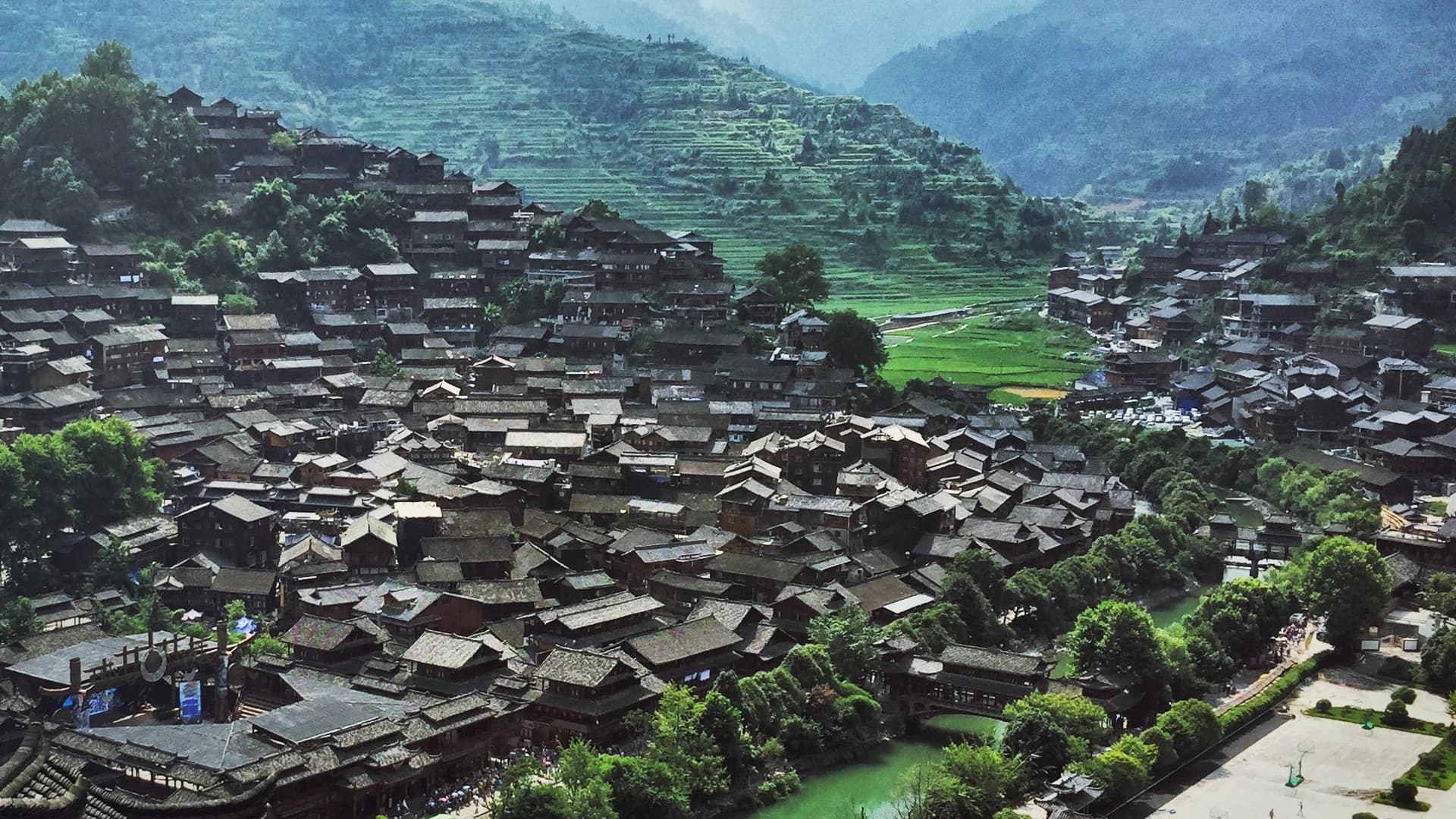
Qiandongnan stretches across a deeply folded corner of eastern Guizhou where the Qingshui, Wuyang and Duliu river systems divide forested mountains, cultivated valleys and rice terraces. The terrain gives the prefecture its dispersed character: Zhenyuan’s river city, Leigong Mountain’s Miao villages and the Dong-speaking south around Rongjiang, Congjiang and Liping belong to one Destination, but not to one compact sightseeing circuit. Rain, altitude and mountain-road conditions can change the pace quickly.
Miao, Dong and other communities have shaped distinct settlement, farming, craft, music and ritual traditions across Qiandongnan. Timber drum towers and roofed bridges, hillside stilt houses, embroidery, silverwork and Dong Grand Song remain parts of community life rather than a single regional costume. Villages are inhabited places with their own histories and contemporary choices; visit them as guests, distinguish one community from another and avoid treating residents as performers or remnants of an unchanged past.
Recommended itineraries
Recommended itineraries
Qiandongnan is too dispersed for a rapid checklist. Use Zhenyuan, Kaili or Leishan, and the Congjiang–Liping area as separate bases. A focused Zhenyuan visit needs two days; the longer prefecture route gives villages and mountain transfers real time.
Zhenyuan heritage on foot
A compact route through the old town’s river edge, cliff architecture, lanes and elevated city views.
- Begin along the Wuyang riverfront before the busiest hours, then cross Zhusheng Bridge to explore the released areas of the Qinglong Cave complex. Continue through the ancient lanes to Tianhou Palace, allowing extra time for steep steps and residential passages. Climb only the currently open route toward Shiping Mountain and the old city wall, then return to the riverfront after dark without depending on a boat service.
Zhenyuan river and memory
A slower plan that separates the old town from Wuyang’s managed scenic corridor and Zhenyuan’s twentieth-century history.
- Day 1 · Follow the heritage-day route through the riverfront, Zhusheng Bridge, Qinglong Cave, ancient lanes, Tianhou Palace and the open Shiping Mountain path.
- Day 2 · If the Wuyang River scenic route and licensed boats are operating safely, give the morning to the managed river excursion. Back in town, visit Zhou Dawen Former Residence and the Heping Village site with the care expected at memorial spaces. If water services are suspended, use the extra time for the old town’s museum or other officially open heritage buildings rather than substituting unregulated rafting.
Across Qiandongnan without reducing it to a village checklist
A multi-base route connecting the river heritage of Zhenyuan, the Miao cultural landscape around Xijiang and the Dong-speaking south, with one deliberate choice rather than an impossible final-day sprint.
- Day 1 · Follow the Zhenyuan heritage route along the Wuyang riverfront, Zhusheng Bridge, Qinglong Cave and the ancient lanes. Stay overnight rather than transferring after dark.
- Day 2 · Move to Xijiang and explore on foot after the main arrival rush. Give priority to the inhabited lanes, architecture and craft context rather than building the evening around a staged performance.
- Day 3 · Transfer toward Rongjiang. Visit Zaidang only when current public access and locally arranged transport are confirmed; Dong Grand Song is community heritage, not an on-demand show.
- Days 4–5 · Base around Zhaoxing. Use one day for its drum towers, bridges and lived-in neighborhoods, then walk only the officially open route toward Tang’an or use managed transport if rain, heat or mobility makes the old path unsuitable.
- Day 6 · Choose one extension that fits your onward route: Jiabang’s working rice terraces from the Congjiang side, or Longli Ancient Town toward Jinping and Liping. Confirm the return connection before leaving your base and do not try to combine both.
Attractions & practical tips
What to see—and how to approach it.
Zhenyuan Ancient Town
镇远古城
The Wuyang River bends through a historic city of old streets, lanes, bridges, wharves, walls and residences, dividing the former prefectural and garrison quarters while holding them in one landscape.
Practical tips
- Explore early and after dusk, but remember that the lanes remain residential. Keep voices down, leave doorways clear and ask before photographing people or private courtyards.
- The core is best approached on foot. Follow current pedestrian controls and confirm ticket or vehicle restrictions locally; allow more time than the short map distances suggest.
Qinglong Cave Ancient Architectural Complex
青龙洞古建筑群
Rather than a single cave, this is a cliff-hugging ensemble of temples, halls, academy and guild architecture where Buddhist, Daoist, Confucian and mercantile traditions meet.
Practical tips
- Check the current opening areas at the entrance; conservation work, fire controls or weather can change access inside the complex.
- Expect narrow stairs, low thresholds and active worship spaces. Do not buy unsolicited ritual services, burn incense outside designated areas or touch painted and carved surfaces.
Zhusheng Bridge
祝圣桥
The multi-arched stone bridge beside Qinglong Cave has connected the two sides of Zhenyuan’s river landscape for centuries and remains one of the town’s clearest architectural anchors.
Practical tips
- Cross on foot and pause only where space allows; do not block the narrow pedestrian flow for a staged photograph.
- Stone can become slick after rain or river mist. Keep away from the parapet edge and never descend to exposed river rocks.
Zhenyuan’s ancient lanes
镇远古巷道
Stepped lanes climb away from the river through traditional houses, small courtyards and angled doorways shaped by the town’s steep terrain and long urban history.
Practical tips
- Wander slowly, but distinguish a public lane from a private threshold. Do not enter courtyards or photograph residents without permission.
- Wear shoes with grip and keep the route modest after rain; polished stone, uneven steps and poor visibility make shortcuts a bad idea.
Shiping Mountain and Zhenyuan City Wall
石屏山与镇远城墙
Shiping Mountain rises directly behind the old town, with surviving defensive wall sections and high viewpoints that reveal the Wuyang River’s S-shaped passage through the city.
Practical tips
- Confirm the open entrance and closing time locally. The climb is steep, exposed and much harder in heat, rain or low cloud than its urban location suggests.
- Carry water, use handrails and stay on released paths. Do not climb wall masonry or continue beyond a barrier for a wider panorama.
Wuyang River Scenic Area
㵲阳河风景名胜区
Beyond the urban riverfront, the national scenic area follows a karst river corridor of forested cliffs, gorges and quieter water landscapes connected to Zhenyuan.
Practical tips
- Treat the scenic excursion as a separate half-day and verify the operating pier, licensed boat, return time and included section on the day of travel.
- Water level and storms can suspend routes. Wear the provided life jacket, remain seated when instructed and never replace a closure with an unlicensed boat or improvised swim.
Tiexi Scenic Area
铁溪景区
A tributary valley northeast of the old town combines forest, karst rock and clear pools in the wider Wuyang River scenic system.
Practical tips
- Confirm that the route is open before leaving town; rain, maintenance and water conditions can change which trail sections are usable.
- Use the managed path, wear shoes with grip and do not swim in apparently calm pools or enter caves and forest side paths independently.
Zhenyuan Tianhou Palace
镇远天后宫
This inland Mazu temple and former Fujian guild hall records how waterborne trade carried coastal beliefs into southwest China, where they became part of Zhenyuan’s multiethnic cultural landscape.
Practical tips
- The approach includes a long, steep staircase. Take your time and keep the central passage clear for worshippers and local visitors.
- Dress and speak respectfully, ask before photographing rituals, and do not touch roof carvings, tablets or altar objects.
Zhou Dawen Former Residence
周达文故居
A late-Qing courtyard residence introduces the early life and revolutionary career of Zhenyuan-born Zhou Dawen while preserving the domestic scale of a historic town house.
Practical tips
- Confirm opening hours locally and allow time to read the interpretation instead of treating the courtyard as a decorative photo set.
- This is both a protected residence and a memorial. Keep voices low, do not sit on displays and distinguish documented history, exhibition interpretation and political rhetoric rather than treating every label as the same kind of evidence.
Heping Village Site
和平村旧址
The preserved site of the wartime Second Prisoner-of-War Camp documents Japanese prisoners held in Zhenyuan, antiwar organizing and a difficult chapter of the Second Sino-Japanese War.
Practical tips
- Approach it as a memorial and historical archive, not a themed attraction. Read labels carefully, keep voices low and avoid playful or posed photographs.
- Some interpretation may be Chinese-only. A translation tool helps, but do not flatten prisoners, staff and antiwar activists into a single uncomplicated story.
Xijiang Thousand-Household Miao Village
西江千户苗寨
Xijiang brings together connected hillside neighborhoods of timber stilt houses, lanes, rice fields and craft traditions in one of Qiandongnan’s best-known Miao cultural landscapes.
Practical tips
- Reserve and enter through the current official system on busy dates, then walk beyond the main commercial street at a residential pace. Do not enter homes, workshops or fields without invitation.
- Ask before photographing residents, clothing or silverwork. A scheduled stage program is not a substitute for understanding the community’s history, and everyday dress should not be treated as costume.
Zaidang Dong Village
宰荡侗寨
Zaidang, in the Rongjiang area, is a Dong village associated with timber architecture and the community transmission of Dong Grand Song.
Practical tips
- Confirm public access and locally arranged transport before setting out; do not rely on an old claim that a performance or homestay will be available.
- Dong Grand Song is living community heritage taught across generations. Listen only when invited or at an announced program, keep recordings unobtrusive and never ask residents to perform on demand.
Zhaoxing Dong Village
肇兴侗寨
Zhaoxing sits in a mountain basin where timber homes, drum towers, roofed bridges, streams and cultivated slopes form a large living Dong settlement and an important base for the Liping village network.
Practical tips
- Allow an overnight stay so the village is more than an arrival-hour photograph. Keep lanes, bridges and drum-tower gathering spaces clear for residents and ask before photographing people.
- Timber villages have strict fire controls. Smoke only where explicitly allowed, carry no open flame into wooden buildings and follow any temporary access or performance notices.
Tang’an Dong Village and terraces
堂安侗寨与梯田
Tang’an lies above Zhaoxing within a connected Dong village and farming landscape of drum-tower architecture, rice terraces, forest and footpaths.
Practical tips
- Use the currently released path or managed road connection from Zhaoxing. The old stone route includes uneven climbs and becomes slippery in rain; turn back if barriers or weather make it unsafe.
- The terraces are working fields, not open viewing platforms. Stay on public paths, do not step onto planted banks and leave gates, irrigation channels and drying racks undisturbed.
Longli Ancient Town
隆里古城
Longli in Jinping County preserves the street plan, gates, pebble-patterned lanes and residential fabric of a Ming military settlement whose later community traditions developed through centuries of migration and exchange.
Practical tips
- Do not confuse Longli Ancient Town in Jinping with Longli County near Guiyang. Confirm transport and opening arrangements before using it as the final stop of a cross-prefecture route.
- The old town is inhabited. Keep to public lanes, avoid blocking doorways, ask before entering ancestral or residential spaces and do not treat living traditions as military-themed entertainment.
Jiabang Rice Terraces
加榜梯田
In Congjiang County, long bands of working rice terraces curve around mountain slopes and Miao villages, reflecting generations of farming knowledge rather than a fixed scenic backdrop.
Practical tips
- Choose Jiabang as its own transfer day and verify the current scenic route, vehicle access and return connection. Fog, planting, water-filled fields and harvest each produce a different landscape.
- Use managed viewpoints and public paths. Do not enter planted terraces, fly a drone over homes without permission or continue onto an exposed mountain road during heavy rain.
Food & dining
Eat with a little local context.
Qiandongnan cooking moves between sour broths, chile, preserved fish and greens, sticky rice and deeply savory meat dishes. Choose busy, licensed kitchens and ask about fish pricing, fine bones, pork, offal, alcohol, peanuts and chile before the kitchen starts.
Sour soup fish
酸汤鱼
Freshwater fish is cooked at the table in a bright, chile-tinged sour broth, a signature flavor across Qiandongnan with many household and restaurant variations.
Try it this way: Confirm the fish species, price by weight and whether the broth contains fermented ingredients or alcohol; ask staff to help with fine bones.
Red sour broth
红酸汤
A vivid local sour base built around red chile and tomato-like acidity is used for hotpots, fish and vegetables.
Try it this way: Ask whether you are ordering a broth, a full hotpot or a fish dish, and request a less spicy dip if the soup itself is already intense.
Aged daocai greens
陈年道菜
Zhenyuan daocai preserves local mustard greens through a labor-intensive traditional process, producing a savory condiment or ingredient with deep regional identity.
Try it this way: Taste a small portion first because salt and intensity vary, and check packaged products for a sealed label, ingredients and shelf life.
Three-flavor stinky tofu
三味臭豆腐
Fried tofu balances a crisp exterior and soft center with aromatic, salty and chile-seasoned toppings.
Try it this way: Order it freshly cooked from a busy stall or licensed restaurant, and ask whether the sauce contains peanuts, sesame or animal stock.
Rice tofu
米豆腐
Rice batter is cooked with alkaline water until set, then cut into tender pieces and dressed with chile, scallion, soy, peanuts and other crisp garnishes.
Try it this way: It contains rice rather than soy tofu, but the dressing may include peanuts, sesame, soy or animal-based seasonings; ask if you have allergies or dietary restrictions.
Guizhou beef rice noodles
贵州牛肉粉
Rice noodles arrive in a deeply flavored beef broth with sliced or diced beef, pickled greens, scallion, coriander and optional fried chile.
Try it this way: Specify your chile level before serving and ask for no coriander or pickled greens if needed; the broth is not vegetarian even when ordered without meat.
Xijiang chicken porridge
西江鸡稀饭
Chicken is cooked with fresh rice porridge so the broth enriches the grain while the meat remains a separate centerpiece, finished simply with salt and local condiments.
Try it this way: Confirm whether the portion is priced by whole or half chicken before ordering, and ask for the meat to be cooked through and the chile dip served separately.
Stir-fried beef tendon
炒牛背筋
Pieces of beef tendon and shank are stir-fried with chile and aromatics for a chewy, deeply savory dish associated with the Dong-village route around Zhaoxing.
Try it this way: The texture is intentionally firm. Ask about the chile level, serving size and any chicken mixed into the dish, and note that it is neither halal by default nor suitable for vegetarian diners.
Miao-style pickled fish
苗家腌鱼
Fish is preserved through a sour fermentation that develops a strong aroma and layered salty, tangy and chile flavors in Miao food traditions.
Try it this way: Try it at a busy, licensed kitchen and ask how it is prepared and served. It can contain fine bones, substantial salt, chile and fermented rice or alcohol ingredients.
FAQ
Questions worth answering before you go.
How many days do I need for Zhenyuan?
One full day covers the historic core at a steady pace. Two days is better if you want the wider Wuyang River scenic route, Tiexi or the modern-history sites without compressing steep walks and museum visits. Keep extra time for weather or temporary access changes.
How does rain affect a Zhenyuan visit?
Rain makes the old stone lanes and mountain paths slippery, while high water or storms can suspend boats and close scenic sections. Check same-day official notices, carry rain protection and let barriers override the itinerary. Never substitute unregulated rafting or swimming for a closed water route.
Is Zhenyuan easy to explore on foot?
The riverfront is comparatively gentle, but the ancient lanes, Tianhou Palace, Qinglong Cave and Shiping Mountain involve uneven stone, narrow passages and sustained stairs. Wear shoes with grip, use handrails and choose the river-level heritage if steps are a barrier. Confirm accessibility at each staffed site rather than assuming the whole old town is step-free.
What etiquette matters at religious and memorial sites?
Keep voices low, dress respectfully and follow photography signs. At active temples, do not interrupt worship or accept pressured ritual services. At Heping Village and Zhou Dawen Former Residence, avoid playful poses and take time to read the historical context. Ask before photographing residents in the old lanes.
Can I take a river boat or see Zhenyuan’s dragon boats?
Use only a currently licensed sightseeing service from an operating pier, with the required life jacket; routes change with water level and event controls. Dragon-boat activity is tied to announced festival or competition dates, not a daily performance. Watch from designated areas, follow crowd controls and never enter a race or training channel.
How many days do I need for wider Qiandongnan?
Two days works for Zhenyuan alone. Allow about six days to connect Zhenyuan, Xijiang and the Zhaoxing area without turning every transfer into a late arrival; seven or eight days is better if you want Jiabang, Longli or another village extension. Cut a geographic block rather than compressing three distant bases into a short trip.
How should I plan transport between the prefecture’s bases?
Treat Kaili or Kaili South, Zhenyuan and Congjiang as separate rail gateways, then verify the current licensed bus, scenic shuttle or prearranged vehicle for each village leg. Mountain distances are slower than they look, and an old through-bus schedule is not a safe planning assumption. Confirm the last return before leaving a station or staffed visitor center.
How can I visit Miao and Dong villages respectfully?
Start by recognizing that Miao and Dong communities are distinct and that each village has its own history and rules. Stay on public lanes, ask before entering homes or photographing people, pay fairly for guiding and crafts, and never request dress, songs, ceremonies or alcohol rituals on demand. Describe residents as contemporary hosts and makers, not as primitive or frozen in time.
What weather and fire risks matter in the village routes?
Heavy rain can trigger slippery stone, high water, landslide risk and temporary mountain-road or trail closures. Check official weather and transport warnings, and never push through a barrier or flooded section. In dense timber villages, obey all no-smoking and fire controls, carry no open flame into wooden buildings and keep emergency lanes clear.