
Last reviewed
Background
Water, stone and six centuries of movement
Anshun sits in a water-shaped karst landscape where rivers drop across faulted limestone, disappear into caves and re-emerge among forest and farmland. Huangguoshu is the most dramatic expression, but its Great Waterfall, Tianxingqiao and Doupotang zones are only one part of a wider natural system that also includes Longgong’s underground river and cave chambers. Water level, mist and trail conditions change with rainfall, so the experience is seasonal rather than a fixed postcard.
Anshun’s cultural geography is equally layered. Ming-era military settlement and later exchange with surrounding communities shaped a network of Tunpu villages, stone architecture, local speech, dress and dixi mask drama. Tianlong and the Yunfeng villages are living communities rather than preserved stage sets, while nearby Bouyei villages maintain their own building and batik traditions. Read these places as histories of migration, adaptation and continuing local life—not as people frozen in the Ming dynasty.
Recommended itineraries
Recommended itineraries
Timed entry, peak-season queues and the real walking distances make a same-day Huangguoshu and Longgong combination unrealistic. Give Huangguoshu two days, then add Longgong and Tunpu as separate Anshun days.
Huangguoshu without rushing
A practical split across the three official scenic zones, with room for timed entry, shuttles, wet paths and pauses at the falls.
- Day 1 · Enter in your reserved period and follow the current shuttle plan to Doupotang and the Great Waterfall zone. Walk to the released viewpoints around Rhinoceros Pool, and enter Water Curtain Cave only with a separate successful reservation and safe conditions. Do not build the day around a rainbow or cave access; neither is guaranteed.
- Day 2 · Give Tianxingqiao the day. Continue beyond the busiest upper section only if your time, mobility and the open route allow, using the signed path through the karst garden toward the lower-zone water landscapes and Silver Chain Falls. Return by official transport rather than improvising a shortcut.
Anshun’s karst and Tunpu landscape
A fuller Anshun route that keeps the waterfall system, cave boats and inhabited heritage villages in realistic separate blocks.
- Days 1–2 · Follow the two-day Huangguoshu plan, separating the Great Waterfall and Doupotang from a full Tianxingqiao day.
- Day 3 · Visit Longgong on its currently released cave-and-water route. Treat boat operations, queues and any cave closure as the day’s pacing constraints rather than adding Huangguoshu afterward.
- Day 4 · Choose one Tunpu focus: Tianlong for a more concentrated introduction, or Yunfeng’s village network for slower lanes and protected stone architecture. Add Shitouzhai only when community access and transport fit; do not race between villages for costume photographs or a guaranteed performance.
Attractions & practical tips
What to see—and how to approach it.
Huangguoshu Great Waterfall
黄果树大瀑布
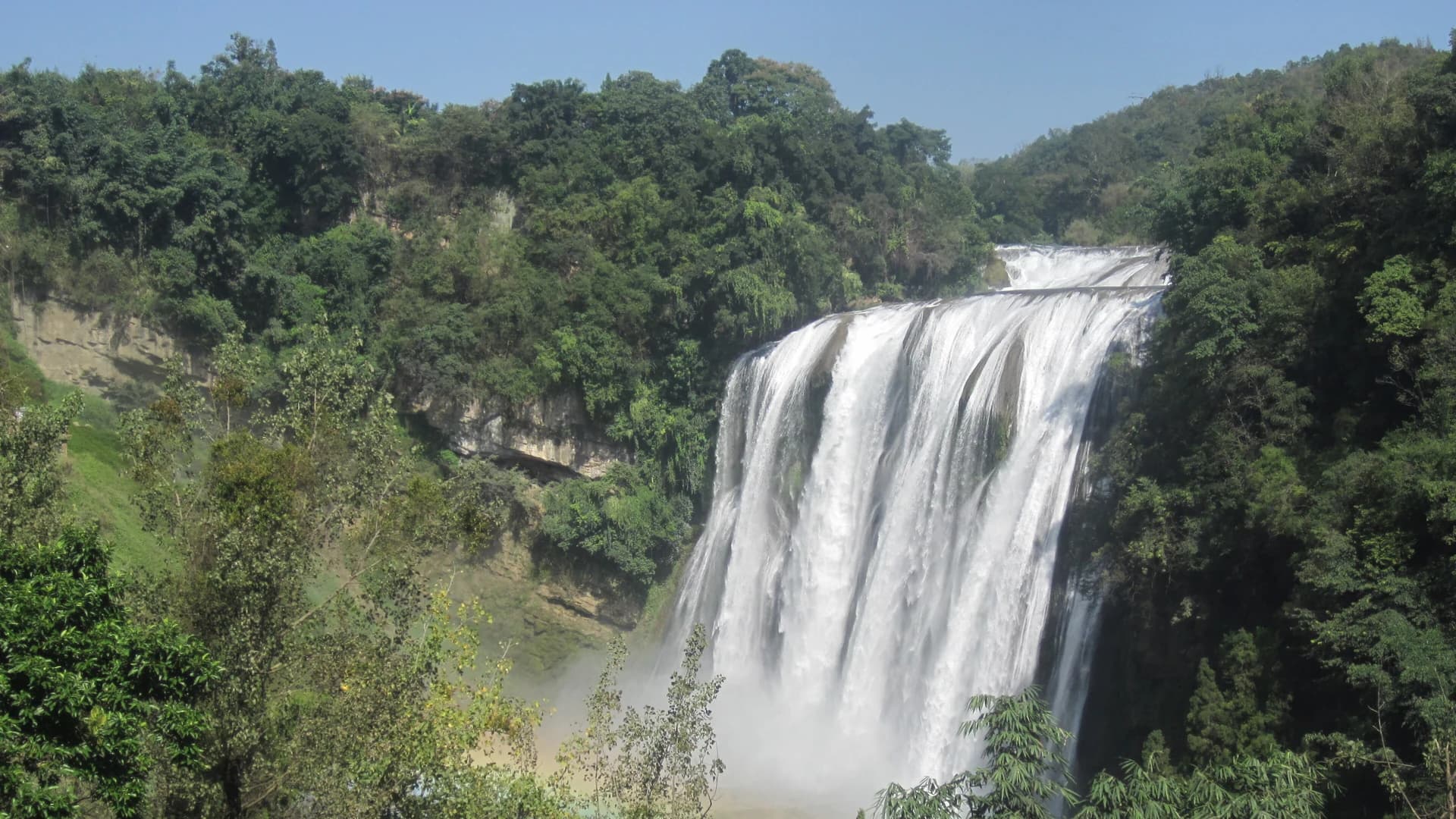
The Baishui River drops across a broad limestone face into a deep gorge, creating the central landmark of the Huangguoshu waterfall group and a powerful mist-filled landscape in higher water.
Practical tips
- Reserve the scenic area through the current official channel and arrive for the booked entry period. Peak dates can reach capacity, and old walk-up or third-party advice is not reliable.
- Use released viewpoints and expect spray, stairs and slow-moving crowds. Protect electronics, wear shoes with grip and never step over a barrier or descend toward the river.
Water Curtain Cave
水帘洞
A natural passage runs behind the Great Waterfall, opening through rock windows to close views of falling water, mist and the gorge.
Practical tips
- During the 2026 summer system, cave access requires a separate free reservation through the official Anlv Tong channel; recheck the official rules for your date and avoid paid third-party reservation claims.
- Access can change with water and crowd conditions. Expect confined wet steps, keep both hands available and do not touch the falling water, rock formations or safety installations.
Rhinoceros Pool viewpoints
犀牛潭观景区
The deep pool and gorge below Huangguoshu gather the waterfall’s impact and mist, creating the classic frontal perspective back toward the main drop.
Practical tips
- Use the signed viewing platforms and leave room for people moving through the narrow approach; mist can make floors slick even without rain.
- A rainbow depends on sun angle, spray and water volume. Do not cross barriers, climb wet stone or enter the pool in pursuit of a photograph.
Tianxingqiao Scenic Area
天星桥景区
Tianxingqiao threads paths through a dense karst garden of stone, water, forest and caves before opening into the lower-zone river and waterfall landscapes.
Practical tips
- The official 2026 visitor notice estimates about five hours for the full route. Decide before entering whether you have the time and mobility for both upper and lower sections.
- Follow the one-way signs and current exit plan. Steps, wet rock and bottlenecks around narrow features make rushing or reversing the route unsafe.
Silver Chain Falls
银链坠潭瀑布
Water divides across rounded travertine shelves into many narrow strands before collecting in a lower pool, giving Tianxingqiao a finer-textured counterpoint to the Great Waterfall.
Practical tips
- Reach it only through the currently open lower Tianxingqiao route and allow enough time to continue to the designated exit.
- Flow changes markedly with rainfall and season. Stay on the viewing path and never walk onto the rounded wet shelves.
Doupotang Waterfall
陡坡塘瀑布
A wide, low waterfall spreads across the river upstream of the Great Waterfall, with a gentler horizontal profile and its own wetland and forest setting.
Practical tips
- Allow a separate visit rather than treating it as a roadside photograph; current guidance estimates roughly two hours for the full zone.
- Walking on the waterfall crest is prohibited. Keep to the released boardwalk, do not feed or approach waterbirds and stay clear of the channel during rising water.
Longgong Scenic Area
龙宫景区
Longgong concentrates Anshun’s cave karst into underground river passages, chambers, springs, cliffs and a cave-mouth waterfall explored partly by managed boat.
Practical tips
- Confirm the day’s released route, boat operation and reservation requirements before arrival; water and cave safety controls determine what is accessible.
- Wear the provided life jacket, keep hands and equipment inside the boat and expect damp steps, low light and temperature change. Do not enter side passages independently.
Shitouzhai
石头寨
This Bouyei village near the Huangguoshu corridor is known for stone-built houses and local batik practice within an inhabited rural landscape.
Practical tips
- Confirm that visits and demonstrations are currently welcomed. Homes, lanes and workspaces are private unless a resident or guide invites you in.
- Ask before photographing people, pay fairly for interpretation or batik and distinguish handmade work from mass-produced souvenirs. Do not describe Bouyei culture as a timeless display.
Tianlong Tunpu
天龙屯堡
A historic post on the route into southwest China developed into a Tunpu settlement whose stone lanes, courtyard houses, local customs and dixi drama preserve a distinctive history of migration and exchange.
Practical tips
- Treat Tianlong as a living town, not a costume set. Ask before entering courtyards or photographing residents, and keep doorways and lanes clear.
- Dixi is a community tradition, not an on-demand attraction. Check the current program, do not assume an old performance interval and approach masks and narratives with cultural context.
Yunfeng Eight Villages
云峰八寨
A network of Tunpu settlements south of central Anshun preserves linked stone villages, defensive forms and courtyard architecture, with Yunshantun and Benzhai among its best-known protected places.
Practical tips
- Choose one or two villages and walk at community pace instead of treating all eight as a rapid circuit. Verify the current public route and transport before leaving Anshun.
- Protected buildings and ordinary homes sit side by side. Stay on public lanes, do not climb walls or towers and ask before photographing residents or interior spaces.
Food & dining
Eat with a little local context.
Anshun’s snacks move between rice, buckwheat, sesame, chile and rich pork flavors. Choose busy, licensed kitchens and ask directly about pork, blood, offal, peanuts, sesame and chile before ordering.
Changwang noodles
肠旺面
Fine egg noodles are served in a red, savory broth with pork intestine, cubes of pig’s blood, scallion and chile for one of Anshun’s richest breakfast bowls.
Try it this way: The standard dish contains pork offal and blood and is not halal or vegetarian. Ask about chile level and choose a busy, licensed noodle shop.
Chongchong steamed rice cake
冲冲糕
Granular glutinous-rice flour is steamed in a small mould, then finished with a sweet mixture that may include rose sugar, sesame, walnut, peanut and candied winter melon.
Try it this way: Eat it warm, and ask about peanuts, tree nuts and sesame before ordering because they are common rather than decorative toppings.
Fried rice cake with rice porridge
油炸粑稀饭
Crisp pieces of fried glutinous-rice cake are added to a smooth rice paste with local seasonings, creating a breakfast of contrasting crunchy and soft textures.
Try it this way: Ask whether the seasoning contains peanuts, sesame, soy or animal fat, and let freshly fried pieces cool before biting.
Buckwheat jelly
荞凉粉
Set buckwheat jelly is sliced or scraped into strips and dressed with chile oil, fermented bean curd, fried soybeans, peanuts and savory sauces.
Try it this way: Specify your chile level and ask about peanut, soy and fermented-bean-curd ingredients. The jelly may be plant-based, but the dressing is not automatically vegetarian.
Zhenning bobo candy
镇宁波波糖
Also called bobo crisp or luokousu, this wheat-gold confection breaks down quickly in the mouth and leaves a pronounced sesame aroma.
Try it this way: Check the ingredient label for sesame, peanuts, malt sugar and other allergens, and buy sealed pieces if carrying them in humid weather.
Five-color sticky rice
五色糯米饭
Naturally tinted glutinous rice appears in the food traditions of communities around Anshun, particularly in seasonal and festival contexts.
Try it this way: Treat festival food as community practice rather than a guaranteed daily product. Buy only where it is offered normally, ask before photographing preparation and check for plant dyes, peanuts and animal-based accompaniments.
FAQ
Questions worth answering before you go.
How many days do I need for Anshun?
Allow two days for Huangguoshu’s three zones at a realistic pace. Add one day for Longgong and another for Tianlong or Yunfeng if you want Anshun’s cave and Tunpu landscapes as well. During the 2026 summer peak, the scenic area itself recommends leaving additional room for crowding and slow sections.
What must I reserve for Huangguoshu?
Reserve scenic-area entry through the current official channel and follow the selected entry period. In the 2026 summer system, Water Curtain Cave requires a separate free reservation through Anlv Tong; the scenic area states that it has not authorized paid third-party cave reservations. Rules and time slots are date-sensitive, so recheck before travel.
When is the waterfall most impressive, and what can rain change?
Higher summer rainfall often gives the falls greater volume, while drier periods reveal more of the rock profile. Heavy rain can also create spray, slippery paths, high water and temporary closures. Check the short-range forecast and official notices, carry rain protection and never enter a closed cave, river edge or waterfall route.
How demanding is Huangguoshu on foot?
The zones are dispersed and combine shuttles with long walks, stairs, wet surfaces and bottlenecks. Current official estimates are about three hours for the Great Waterfall, two for Doupotang and five for the full Tianxingqiao route. Use released mobility services where suitable, choose a shorter zone rather than rushing and confirm accessibility with the staffed site.
How should I visit Tunpu and Bouyei villages?
Remember that these are inhabited communities. Stay on public lanes, ask before entering homes or photographing people, pay fairly for interpretation and crafts, and do not request costumes or performances on demand. Dixi, batik, dress and stone architecture belong to distinct local histories; avoid calling residents ancient, untouched or frozen in time.