Last reviewed
Background
An oasis where routes, religions and artistic traditions met.
Dunhuang sits near the western end of the Hexi Corridor, where an oasis supported travelers moving through a network of routes toward Central Asia. Han frontier sites, beacon lines and passes make that movement visible, but the Silk Roads were never one caravan trail: merchants, envoys, monks and local communities connected many changing routes over centuries.
The city’s cultural depth reaches far beyond desert scenery. Mogao’s caves preserve a millennium of Buddhist art shaped by exchange among China, Central Asia and India, while West Thousand Buddha Caves, museums and earthen frontier remains reveal different parts of the same regional story. Mingsha Mountain, Crescent Lake and the yardang landscape show how water, wind and extreme aridity continue to shape life around the oasis.
Recommended itineraries
Build each day around distance, light and protected-site access.
Mogao requires its own reservation logic, while the western desert sites involve long road transfers. Keep those constraints separate instead of compressing Dunhuang into one checklist.
First Dunhuang in three days
A focused introduction to cave art, oasis history and one long frontier-landscape circuit.
- Day 1 · Begin at Dunhuang Museum for geographic and archaeological context, continue to White Horse Pagoda if current access suits, then explore Shazhou Night Market as an evening food walk rather than a souvenir checklist.
- Day 2 · Follow your reserved Mogao Caves program from the official Digital Exhibition Center. Rest during the hottest part of the day, then visit Mingsha Mountain and Crescent Lake later only after checking the current admission window and weather.
- Day 3 · Use a licensed driver or regulated tour for Yumen Pass, surviving Han Great Wall and Hecang Fortress, continuing to Dunhuang Yardang Geopark only when current road, weather and park operations make the full circuit realistic.
Caves, passes and the living oasis
A slower route that gives the two cave systems, northern frontier and southwestern pass separate attention.
- Day 1 · Dunhuang Museum, White Horse Pagoda and an unhurried city evening with local noodles or lamb soup.
- Day 2 · Reserve most of the day for the official Mogao sequence, including its digital interpretation and guided cave visit; do not place a fixed sunset booking immediately afterward.
- Day 3 · Travel the northern and western circuit to Yumen Pass, the Han wall, Hecang Fortress and the yardang landscape with daylight, water and a current return plan.
- Day 4 · Visit West Thousand Buddha Caves and Yang Pass on a separate southwestern circuit, then finish at Mingsha Mountain and Crescent Lake only if weather, seasonal hours and energy align.
Attractions & practical tips
What to see—and how to approach it.
Mogao Caves
莫高窟
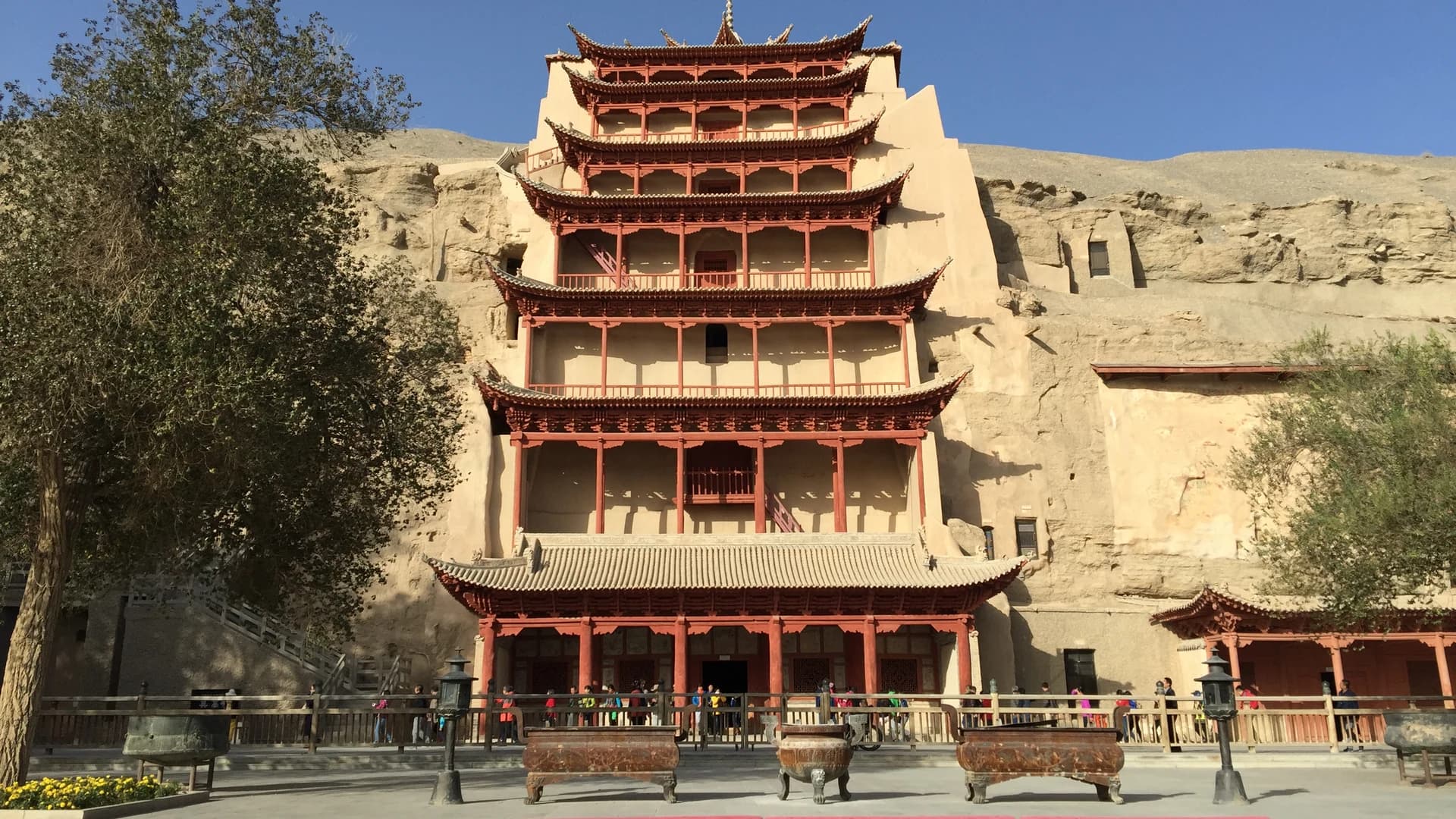
A World Heritage cave complex whose murals, painted sculpture and manuscripts document roughly a thousand years of Buddhist art and exchange along the Silk Roads.
Practical tips
- Book only through the official Mogao reservation channels, match the reservation to your valid travel document and begin at the Digital Exhibition Center rather than driving directly to the caves.
- Cave access changes for conservation and weather. Photography and video are prohibited inside the caves, and touching murals or sculpture is never permitted.
Mingsha Mountain and Crescent Lake
鸣沙山月牙泉
High dunes surround a spring-fed crescent of water at the oasis edge, bringing Dunhuang’s desert geology and dependence on scarce water into one landscape.
Practical tips
- Check the official seasonal entry window and weather on the day; heat, wind and sand can alter a comfortable plan quickly.
- Carry water and sun protection, keep sand away from cameras and phones, and stay within managed visitor areas rather than treating the dunes as open wilderness.
Dunhuang Museum
敦煌市博物馆
The city museum links oasis settlement, Han frontier administration, Silk Roads exchange and the development of Dunhuang art through local archaeological material.
Practical tips
- Visit before the remote sites so place names, route networks and earthen remains are easier to interpret in the landscape.
- Check the museum’s official notice for current opening and reservation arrangements rather than relying on the PDF’s old schedule.
West Thousand Buddha Caves
西千佛洞
Caves cut into cliffs above the Dang River form a distinct branch of the wider Dunhuang cave-art tradition, rewarding visitors who want to compare scale, chronology and conservation with Mogao.
Practical tips
- Treat this as a separate guided cave visit, not a substitute reached casually after Mogao; current openings depend strongly on natural conditions.
- Leave bags, cameras and filming equipment as directed and follow every no-touch and no-photography rule.
Yumen Pass and Han Great Wall
玉门关与汉长城
The earthen pass, beacon system and wall remains show how Han authorities organized movement and defense at the corridor’s desert edge. Yumen Pass is a component of the transnational Chang’an–Tianshan Corridor World Heritage property.
Practical tips
- The site is remote and exposed; use current official access information and combine it with nearby frontier remains rather than an improvised roadside stop.
- Do not climb earthen walls or leave marked paths. Their weathered appearance reflects vulnerable archaeology, not abandoned structures.
Hecang Fortress
河仓城
Large earthen granary ruins near the Han frontier preserve the logistical side of desert administration: food storage and supply were as important as gates and beacon towers.
Practical tips
- Read the low eroded walls with archaeological interpretation; dramatic silhouettes can otherwise obscure the site’s practical role.
- Use only designated viewpoints and never climb the ruins or surrounding mounds.
Yang Pass
阳关
A Han-era southern gateway remembered through archaeology, a surviving beacon mound and generations of frontier poetry. The visit is strongest when the reconstructed interpretation is distinguished from original remains.
Practical tips
- Pair Yang Pass with West Thousand Buddha Caves on a dedicated southwestern circuit rather than the more distant yardang day.
- Ask what fabric is archaeological and what is reconstructed; poetry and landscape enrich the visit but should not replace evidence.
Dunhuang Yardang Geopark
敦煌雅丹国家地质公园
Wind-eroded ridges and isolated forms rise from a broad gravel desert, showing the scale and geological processes of Dunhuang’s arid landscape.
Practical tips
- Confirm the current park transport, road and weather status before the long drive; sunset plans still need a safe, regulated return.
- Stay with managed routes and carry water, layers and charged communication devices. This is not a place for independent off-road exploration.
White Horse Pagoda
白马塔
A compact pagoda in the oasis landscape, traditionally associated with the monk-translator Kumarajiva’s eastward journey and repeatedly repaired across later periods.
Practical tips
- Treat the origin story as tradition and use visible inscriptions and architectural layers to understand the monument’s later history.
- Check current local access before making a special journey; this is a quiet city stop rather than a major half-day sight.
Shazhou Night Market
沙州夜市
An evening market where noodle stalls, grilled foods, fruit and souvenir shops make Dunhuang’s tourism economy and everyday flavors visible in the city center.
Practical tips
- Go for a small-dish food crawl and compare busy market stalls with ordinary restaurants on nearby streets.
- Ask prices before ordering, avoid objects marketed as genuine antiquities and do not buy copied mural material represented as original heritage.
Food & dining
Eat with a little local context.
Dunhuang food reflects a dry, grain-growing corridor and long movement through the oasis: wheat noodles, chilled starch dishes, lamb and fried sweets are more useful guides than a list of famous restaurants. Sample smaller portions and balance heavy dishes with water and fruit.
Niangpizi
敦煌酿皮子
Cool, springy wheat-starch sheets served with gluten, vinegar, garlic and chili for a sharp, refreshing snack.
Try it this way: Ask for less chili or garlic if needed and choose a busy stall that keeps the prepared ingredients covered and cool.
Jiangshui noodles
浆水面
Wheat noodles in a light, naturally sour vegetable broth, especially refreshing during the hottest months.
Try it this way: The sourness is intentional; try one bowl before adding extra vinegar or chili.
Donkey meat with yellow noodles
驴肉黄面
Fine hand-pulled yellow noodles served beside sliced or braised donkey meat, one of Dunhuang’s best-known paired dishes.
Try it this way: Meat and noodles may be priced separately, so confirm portion size and total price before ordering.
Dunhuang saozi noodles
敦煌臊子面
Handmade wheat noodles in a savory diced-meat and vegetable broth, served as both an everyday meal and a dish for guests.
Try it this way: Regional versions vary in broth and toppings; ask what the house style includes if you avoid pork or particular vegetables.
Lamb and fen soup
羊肉粉汤
Slices of cooked lamb and soft starch pieces served in a hot, aromatic broth, particularly welcome on a cold desert morning or evening.
Try it this way: Confirm the starch ingredient and spice level, and order a small bowl if several rich lamb dishes are already on the table.
Pao'er oil cake
泡儿油糕
A delicate fried pastry whose blistered golden shell encloses a sweet filling, associated with Dunhuang banquet and snack traditions.
Try it this way: Share a freshly fried portion while it is crisp; the pastry is rich and loses texture as it cools.
FAQ
Questions worth answering before you go.
How many days do I need in Dunhuang?
Three full days cover Mogao, the museum and oasis, Mingsha Mountain and one remote western circuit. Four days is better if you want both the Yumen–yardang route and the separate West Thousand Buddha Caves–Yang Pass route without forcing long drives around fixed cave reservations.
How should an international visitor book Mogao Caves?
Use the official Mogao reservation service and its Ticket Booking option for foreign passports, enter the travel document accurately and carry that original document. The 2026 official notice says no third party is authorized to act as a ticket agent, and the cave program can change for conservation, capacity or weather.
Can I photograph inside the Dunhuang caves?
No photography or video is allowed inside the Mogao caves, and West Thousand Buddha Caves also restricts cameras and filming equipment in the cave area. Follow the guide, never touch murals or painted sculpture and use official digital resources for close study afterward.
Can I visit all the western desert sites in one day?
Yumen Pass, the Han wall, Hecang Fortress and the yardang park can form one very long northern-western circuit with regulated transport. Yang Pass and West Thousand Buddha Caves sit on a different southwestern route. Splitting the two produces safer daylight margins and more time to understand fragile sites.
When is Dunhuang easiest to visit, and how should I prepare?
Spring and autumn usually make long outdoor days easier, while summer requires heat planning and winter brings cold, shorter hours and reduced services. In every season check wind, sand, temperature and attraction notices; carry water, layers and sun protection, protect electronics from sand and never leave managed desert routes alone.