Last reviewed
Background
An old Fen River capital where the long history of Jin survives in museums, temples, sculpture and place names.
Taiyuan sits in a broad basin where the Fen River runs south between mountain ranges. The city’s predecessor, Jinyang, served repeatedly as a military, administrative and political center, and the Tang ruling house traced important origins to the area. The old walled city was destroyed in the Northern Song, so much of Taiyuan’s deepest history is now encountered through archaeology, outlying monuments and museum collections rather than one intact ancient core.
As Shanxi’s capital, Taiyuan is the most practical base for understanding the province before traveling to its cave temples, merchant towns and courtyard estates. Coal and heavy industry shaped the modern city, but the visitor experience is broader: major collections interpret the state of Jin and later dynasties, while local performance, vinegar traditions and an unusually diverse noodle culture remain part of everyday urban identity.
Recommended itineraries
Recommended itineraries
Taiyuan’s heritage is spread between the central city and mountain sites to the southwest. Group places by geography, reserve timed museum entries early and avoid treating distant Shanxi attractions as quick city stops.
Essential Taiyuan heritage
A first visit connecting the Jinyang landscape with the provincial collection and the modern riverfront.
- Day 1 · Start at Jinci and continue to Tianlongshan Grottoes only if current access and shuttle arrangements allow enough time; return to central Taiyuan for a relaxed Fen River walk near dusk.
- Day 2 · Give Shanxi Museum a substantial morning, then choose Chunyang Palace or Chongshan Temple before viewing the Twin Pagodas from the park and nearby public areas.
Sculpture, museums and western hills
A slower route that adds Taiyuan’s early Buddhist and Daoist stone heritage without crossing into neighboring Jinzhong.
- Day 1 · Explore Jinci’s architecture, sculpture and garden-water system, then continue to Tianlongshan Grottoes with time for the site interpretation.
- Day 2 · Visit Shanxi Museum, Chunyang Palace and Chongshan Temple, then finish at the Fen River or the Twin Pagoda area.
- Day 3 · Pair Mengshan Giant Buddha with Longshan Grottoes if both sites are open and transport is arranged; keep the day flexible because mountain access can change.
Attractions & practical tips
What to see—and how to approach it.
Jinci
晋祠
This temple, ancestral-hall and garden complex at the foot of Xuanweng Mountain preserves layers of architecture, inscriptions, ancient trees and waterworks associated with the early state of Jin.
Practical tips
- Prioritize the Sacred Mother Hall, its Northern Song attendant figures, the Flying Bridge over the Fish Pond and the water channels instead of rushing every courtyard.
- Separate the protected historic complex from the larger surrounding park, and check current reservation and access rules before traveling.
Tianlongshan Grottoes
天龙山石窟
Caves cut into Tianlong Mountain from the Eastern Wei through the Tang preserve an important sequence of Buddhist sculpture, despite severe twentieth-century looting and the dispersal of many heads and figures overseas.
Practical tips
- Read the site’s conservation and digital-repatriation displays to understand both the surviving carvings and what was removed.
- Mountain roads, shuttles and cave access can change with maintenance or weather; confirm the current route and never touch the sculpture.
Shanxi Museum
山西博物院
The provincial museum introduces Shanxi through archaeology, bronzes, ceramics, sculpture, opera and merchant history, giving essential context for monuments across the province.
Practical tips
- Reserve through the museum’s current official channel and bring the identity document used for booking.
- Allow at least half a day and choose several galleries; attempting the entire collection before another major site usually produces museum fatigue.
Twin Pagoda Temple
双塔寺(永祚寺)
Two tall brick pagodas built during the Ming dynasty form Taiyuan’s best-known historic skyline marker, rising above Yongzuo Temple and its seasonal peony garden.
Practical tips
- Do not assume the towers can be climbed; conservation and visitor-access rules may restrict interiors.
- The pagodas are easy to appreciate from the park and surrounding public viewpoints, especially in softer morning or late-afternoon light.
Mengshan Giant Buddha
蒙山大佛
A colossal cliff-carved Buddha begun in the Northern Qi once overlooked the Jinyang area; after centuries of damage and burial, the surviving rock body was rediscovered and the visible image was extensively restored.
Practical tips
- Read the interpretation carefully so the ancient carved core and modern reconstruction are not mistaken for one untouched sixth-century statue.
- Expect an outdoor uphill approach and check current shuttle, trail and weather conditions.
Chongshan Temple
崇善寺
Most of the once-large Ming temple was lost to fire, but the surviving Great Compassion Hall preserves monumental sculptures and important Buddhist material within central Taiyuan.
Practical tips
- Approach it as an active religious and heritage site: dress respectfully, speak quietly and follow photography restrictions.
- Its compact surviving area pairs well with another central museum or historic street rather than requiring a full day.
Fen River Park
汾河公园
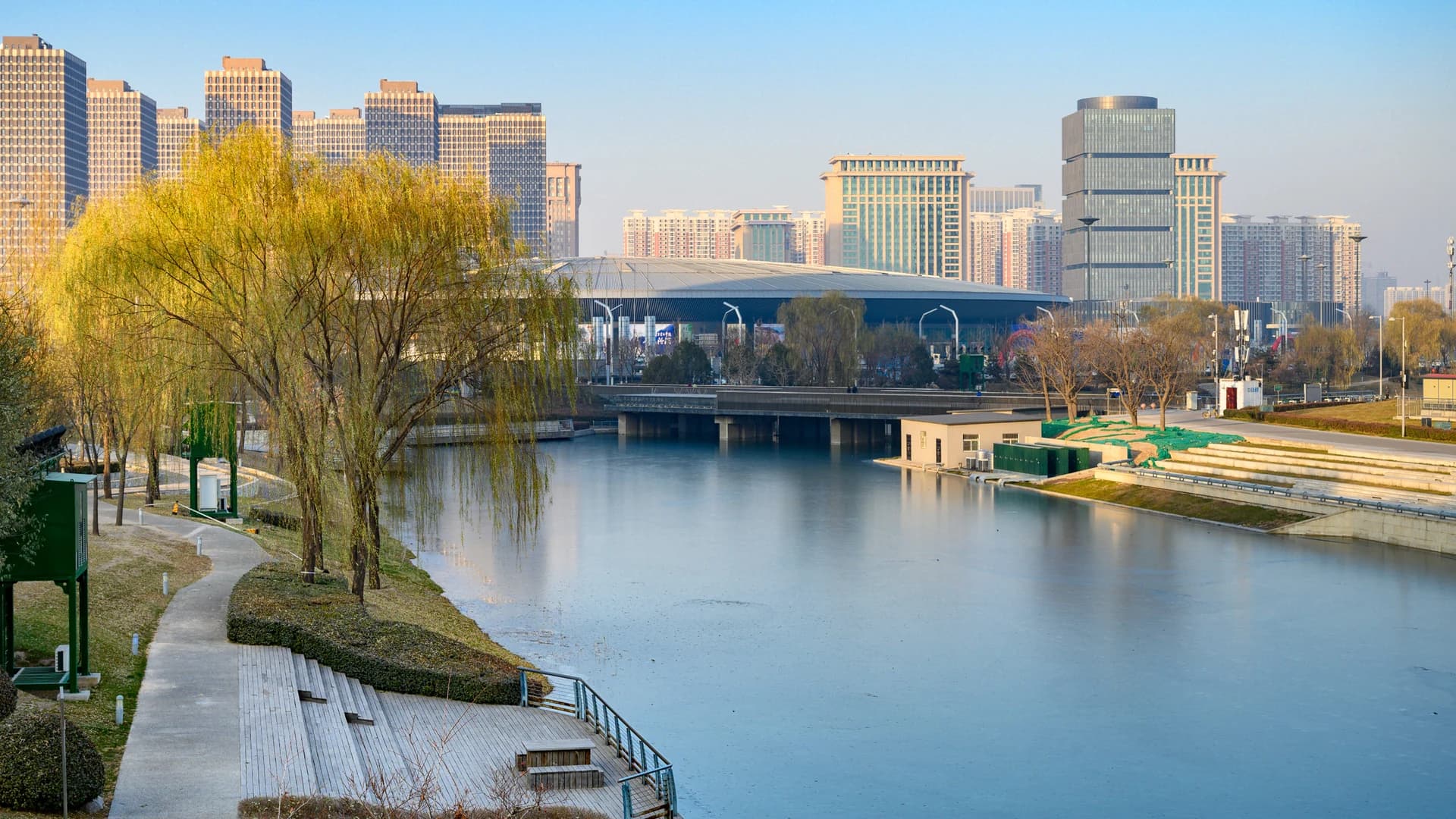
A long landscaped corridor follows the rehabilitated urban Fen River, giving Taiyuan residents space for walking, cycling and evening recreation beside the water.
Practical tips
- Choose one section near your other plans rather than trying to cover the full linear park.
- Dusk is atmospheric, but carry an extra layer outside summer and use well-lit exits for the return journey.
Longshan Grottoes
龙山石窟
Longshan preserves a rare group of Yuan-dynasty Daoist grottoes whose restrained carvings depict deities and religious masters in a mountain setting southwest of the city.
Practical tips
- Do not confuse Longshan’s Daoist caves with the Buddhist grottoes at nearby Tianlongshan.
- Confirm current road, trail and conservation access; combine the site only with nearby western-hill stops and leave time for the approach.
Chunyang Palace
纯阳宫
A historic Daoist complex near the central city is organized around courtyards, halls and an octagonal spatial plan and now presents architecture and stone-carving collections.
Practical tips
- Check the current museum name, exhibition status and reservation channel because institutional arrangements can change.
- Look at the courtyards and building sequence as carefully as the displayed objects; the site itself is a central part of the visit.
Juewei Mountain
崛围山
Northwest of central Taiyuan, Juewei Mountain is known for wooded slopes, long views across the basin and autumn foliage associated with one of historic Jinyang’s scenic traditions.
Practical tips
- Treat it as a hiking outing rather than a quick urban stop, and verify trail, fire-prevention and transport conditions before setting out.
- Autumn color draws heavier crowds; carry water, wear grippy footwear and remain on open marked paths.
Food & dining
Eat with a little local context.
Taiyuan is a strong introduction to Shanxi’s grain craft: wheat, buckwheat and oat doughs are cut, rolled, rubbed, pinched and steamed into distinct forms. Order several small dishes to compare textures, and ask about meat broths, vinegar and chilli before serving.
Taiyuan tounao
太原头脑
A thick breakfast soup traditionally combines lamb, lotus root, Chinese yam, fermented grain and aromatic ingredients, often with flatbread and pickled chives.
Try it this way: Its flavor is mild but distinctive and recipes can contain alcohol-derived seasoning; ask about ingredients rather than treating it as a medicinal cure.
Knife-shaved noodles
刀削面
A cook shaves broad, tapered strips directly from a block of wheat dough into boiling water, producing noodles with soft centers and firmer edges.
Try it this way: Choose your topping and chilli level separately, and eat the noodles as soon as they arrive.
Kaolaolao oat rolls
栲栳栳
Thin pieces of oat dough are curled into small upright tubes, packed together and steamed before being served with a savory dipping sauce or topping.
Try it this way: The sauce may contain lamb or pork even when the rolls look vegetarian, so confirm the broth if that matters to you.
Bulazi
不烂子
Shredded potato or seasonal vegetables are coated lightly in flour, steamed into separate crumbs and often finished in a hot wok.
Try it this way: Ask which vegetable is used that day and whether the final stir-fry includes meat or lard.
Cat-ear noodles
猫耳朵
Small squares of dough are pressed with a thumb into curved shells whose shape catches tomato-and-egg, meat or vegetable sauces.
Try it this way: The name describes only the shape; choose a topping that suits your diet and preferred richness.
Wantuo
碗托
A smooth buckwheat or wheat-flour set cake is sliced and dressed with garlic, mature vinegar and chilli, or stir-fried for a warmer version.
Try it this way: Cold wantuo is best from a clean, high-turnover counter; ask for chilli on the side if you prefer a gentler taste.
FAQ
Questions worth answering before you go.
How many days should I spend in Taiyuan?
Two days cover Jinci, one mountain heritage site, Shanxi Museum and selected central monuments. A third day makes room for Mengshan and Longshan or a northern hill walk without compressing long transfers.
When is the best time to visit Taiyuan?
Late spring and autumn usually provide the best balance for city walks and mountain sites. Summer can be warm and rainy, while winter is cold, dry and occasionally affected by snow or poor mountain access; check conditions before outdoor excursions.
Which Taiyuan sights require advance planning?
Major museums and popular heritage areas may use timed reservations, identity-document checks or holiday crowd controls. Verify official channels for Shanxi Museum, Jinci and Tianlongshan first, then arrange mountain transport around the confirmed slots.
Are Taiyuan’s main sights close together?
No. Shanxi Museum and several temples are central, but Jinci, Tianlongshan, Mengshan and Longshan lie toward the western or southwestern hills. Group nearby places and leave road-time margins instead of crossing the city repeatedly.
Are Pingyao, Yuci and the merchant courtyards part of Taiyuan?
No. They are separate destinations in neighboring Jinzhong and require their own travel time. Taiyuan is a useful rail and air gateway, but those places should not be squeezed into a city itinerary or presented as Taiyuan attractions.