
Last reviewed
Background
A northern capital, frontier stronghold and industrial city whose history remains visible in stone and timber.
Known as Pingcheng when it served as the Northern Wei capital, Datong became a center where imperial patronage, Buddhist practice and exchanges across northern Eurasia shaped the Yungang Grottoes. It later served as a secondary capital under the Liao and Jin and as a fortified Ming frontier city, leaving major temples, walls and trading histories around the modern city.
Coal transformed modern Datong and also left environmental and urban costs. Recent decades have brought cleaner industries, heritage conservation and extensive old-city reconstruction. Visitors should distinguish original fabric, restored monuments and newly rebuilt streets instead of treating the entire walled center as one untouched ancient town.
Recommended itineraries
Recommended itineraries
Keep Yungang, the old city and Hunyuan on separate half- or full-day blocks. Yingxian Wooden Pagoda is in neighboring Shuozhou, so it is not folded into this Datong guide.
Datong essentials
A first visit combining the Northern Wei caves with Datong's surviving Liao-Jin and Ming heritage.
- Day 1 · Give Yungang Grottoes an unhurried half day, reading the cave sequence rather than rushing between famous statues; return for an evening walk around the reconstructed city wall.
- Day 2 · Begin at Huayan Temple, continue to the Nine Dragon Screen, Guandi Temple and Shanhua Temple, and use the streets between them to compare surviving monuments with the rebuilt old-city setting.
Datong and Hunyuan
A slower route adding the cliff-built Hanging Temple and a condition-dependent Mount Heng visit.
- Day 1 · Yungang Grottoes, followed by a relaxed return to central Datong.
- Day 2 · Huayan Temple, Shanhua Temple, the Nine Dragon Screen, Guandi Temple and the city-wall circuit.
- Day 3 · Travel to Hunyuan with prebooked Hanging Temple access. Add a selected Mount Heng area only if weather, time and current transport make it practical; do not combine the excursion with Yingxian and a same-day departure.
Attractions & practical tips
What to see—and how to approach it.
Yungang Grottoes
云冈石窟
Carved into the Wuzhou Mountain cliffs from the fifth century onward, Yungang's major caves trace changes in Northern Wei Buddhist imagery, imperial patronage and artistic exchange across a long east-west corridor.
Practical tips
- Begin with the site museum or introductory displays so the early Tanyao caves and later paired caves make chronological sense.
- Do not touch carvings or use prohibited lighting; check the official site for current reservations and any special-cave access.
Hanging Temple
悬空寺
Built against a cliff in Hunyuan beneath Mount Heng, the compact timber complex uses rock support, beams and closely linked chambers to create its celebrated elevated form.
Practical tips
- Upper-level access is capacity controlled and may sell out even when the lower scenic area remains open; reserve through the official Hengshan channel.
- Passages and stairs are narrow. Follow one-way instructions, carry little and skip the upper structure if heights, mobility or crowding make it unsuitable.
Mount Heng
北岳恒山
The northern sacred mountain rises above Hunyuan with temple compounds, passes and dry northern upland scenery. It is a separate mountain visit rather than another room of the Hanging Temple.
Practical tips
- Choose a realistic section according to current shuttle, cableway and trail operations instead of assuming every temple is reachable in one visit.
- Expect wind and rapid temperature changes; carry water, layers and footwear with grip.
Huayan Temple
华严寺
This major Liao-Jin Buddhist complex is unusual for its east-facing orientation and preserves large timber halls, sculpture and later additions within Datong's old city.
Practical tips
- Allow time for both architecture and sculpture, especially the Lower Temple's preserved statuary.
- Separate historic halls from modern reconstructions and follow current restrictions on indoor photography.
Shanhua Temple
善化寺
Shanhua Temple preserves a calm north-south sequence of Liao-Jin halls and later gates, offering a less crowded lesson in how monumental timber buildings organize space.
Practical tips
- Walk the central axis slowly and compare bracket sets, rooflines and hall proportions rather than treating the site as a quick checklist.
- Check current opening arrangements and respect worship or conservation barriers.
Nine Dragon Screen
九龙壁
The long glazed-tile screen survives from a Ming princely residence, with nine dragons modeled in colored relief above waves and cloud forms.
Practical tips
- View it first from a distance for the full composition, then move closer for tile seams and individual dragon details.
- Combine it with Huayan and Guandi temples on foot rather than making a separate vehicle trip.
Datong City Wall
大同古城墙
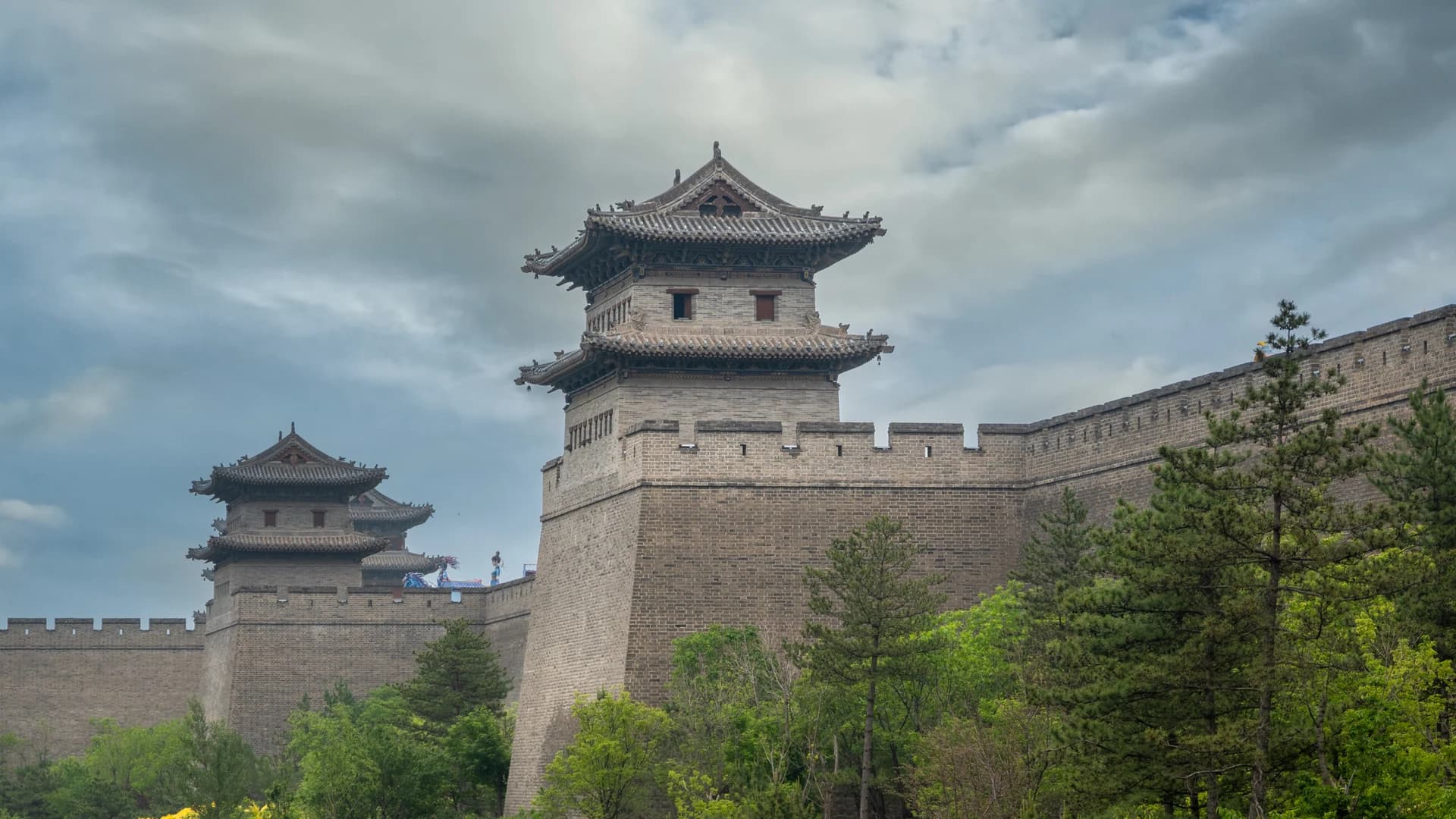
Today's walled-city circuit follows Datong's historic defensive footprint but is largely the result of modern restoration and reconstruction, creating broad views over both monuments and new old-style streets.
Practical tips
- Use the wall as an orientation point while keeping its reconstruction history in view.
- Confirm current gate access and evening hours before planning a complete circuit.
Guandi Temple
关帝庙
This old-city temple dedicated to Guan Yu preserves significant historic architecture amid a surrounding district that has changed substantially.
Practical tips
- Read the site as both a place of worship and a historic guild-and-community institution.
- Keep voices low and ask before photographing ceremonies or worshippers.
Datong Earth Forest
大同土林
Eroded sediment forms narrow pillars, ridges and gullies in a dry landscape outside the urban center, offering a geological counterpoint to Datong's carved and built heritage.
Practical tips
- Check whether the site is officially open and how to return before traveling; operations have been less stable than the major heritage sites.
- Stay on established paths, avoid fragile edges and carry sun, wind and dust protection.
Datong Volcanic Cluster
大同火山群
A field of extinct volcanic cones in Yunzhou District records a much older phase of the region's landscape, with open views across the northern Shanxi plateau.
Practical tips
- Choose a designated visitor area and confirm current access rather than driving between unmarked cones.
- Do not climb closed slopes or remove rock; the exposed terrain offers little shelter in storms, heat or strong wind.
Food & dining
Eat with a little local context.
Datong's northern Shanxi cooking centers on wheat and oat noodles, lamb, cooling starch dishes and strongly seasoned snacks. Portions are usually generous, so begin with fewer dishes and add more only if needed.
Knife-shaved noodles
大同刀削面
A cook shaves strips directly from a block of wheat dough into boiling water, producing noodles with a soft center, firm edges and enough surface to hold a meat or vegetable sauce.
Try it this way: Choose the topping and bowl size first, then add chilli or vinegar gradually.
Youmian oat noodles
莜面
Oat flour is shaped into strips, rolls or honeycomb-like cylinders, steamed and served with a warm lamb sauce or cool vegetables and vinegar.
Try it this way: Ask which shape and sauce the kitchen recommends; the dense noodles are more filling than their portion may suggest.
Hunyuan liangfen
浑源凉粉
Cool, slippery starch jelly is dressed with vinegar, garlic, chilli oil, herbs, crisp beans and pieces of seasoned dried tofu.
Try it this way: Ask for chilli oil on the side if you want to control heat, and eat it freshly dressed.
Guangling dried tofu
广灵豆腐干
Firm pressed tofu from Guangling is seasoned, smoked or braised for a chewy, savory snack that travels more easily than fresh tofu.
Try it this way: Check the seasoning and sealed-product expiry date, especially if buying it for an onward journey.
Lamb hotpot
涮羊肉
Thin slices of lamb cook quickly in a shared pot and are eaten with sesame-based dipping sauce, vegetables, tofu and noodles.
Try it this way: Use separate utensils for raw and cooked lamb and ask whether the broth or sauce contains sesame if allergies are a concern.
Spiced rabbit head
香辣兔头
Rabbit heads are braised with strong spices and eaten piece by piece as a local snack, valued for concentrated flavor rather than a large amount of meat.
Try it this way: Expect small bones and a hands-on meal; choose a reputable busy shop and skip it if the format is outside your comfort zone.
FAQ
Questions worth answering before you go.
How many days should I spend in Datong?
Two days cover Yungang and the principal old-city monuments. Add a third day for Hanging Temple and Mount Heng in Hunyuan; allow another day if you also choose a geological excursion.
When is the most comfortable time to visit?
Late spring through autumn usually offers the easiest conditions for an architecture-focused trip, with cooler summers than many nearby cities. Datong remains dry and exposed: bring layers, sun protection and wind protection, and check the forecast before Mount Heng.
How should I organize transport between the sights?
The central monuments group well on foot or by short ride, while Yungang and Hunyuan are separate road journeys. Use current public transport or a licensed vehicle, keep Chinese place names saved and confirm return arrangements before leaving the city.
Can I always enter the upper Hanging Temple?
No. The scenic area and the upper structure can have separate tickets, timed reservations and strict capacity controls. Reserve through the official Hengshan channel, carry the required identification and expect access to change with crowds, conservation or weather.
Is Datong's old city entirely historic?
No. Major monuments preserve genuine historic fabric, but much of the current wall and surrounding streets reflects recent restoration or reconstruction. Read site interpretation, compare building dates and value the surviving temples and artworks without pretending every street is ancient.